

In late August, Abu Dhabi’s Masdar cancelled a planned 100MW electrolyser project meant to supply green hydrogen (GH2) to Emsteel’s steelmaking at Musaffah.1 There is no reporting that offers a clear reason. However, the cancellation matters because Emsteel had already run a pilot plant on the same site since October 2024, which has made it a rare case of a steelmaker with a working proof of concept.
Masdar isn’t alone. Fortescue scrapped its Arizona and Gladstone projects and blamed a shift in U.S. policy priorities away from green energy. Woodside also dropped H2OK in Oklahoma, citing cost escalation and weaker-than-expected demand.2 Engie and Posco walked away from the $6.7bn HyDuqm project in Oman, roughly 5GW of solar and wind feeding green ammonia, and BP separately withdrew from its 1.5GW Duqm project.3 Oman’s own hydrogen authority said only seven of the nine original winners were still progressing.
So is this simply an electrolyser problem? The evidence says no.
The hardware isn’t the binding constraint
Chinese alkaline electrolysers are reported to cost 60–70% less than most comparable Western units.4 If stack price were the problem, the wave of cancellations should be easing. But it isn’t. Electrolyser capex is only around 15–35% of the levelised cost of hydrogen (LCOH) under typical assumptions, and stack replacement is a mid-project cost that most financial models leave out.5 One Chinese industry forecast has put electricity at 74–89% of GH2 production cost.6 Cheaper hardware doesn’t solve an expensive or ineligible power supply.
LCOH is a single-number metric built for a single production pathway: buy a commodity input, convert it, sell that one product. Electrolysis fits this model seamlessly. Gasification, especially with waste, only fits it if you make several quiet assumptions that tilt the result. Electrolyser LCOH is extremely sensitive to capacity factor and power price, and a cheap-power-only operating system means low utilisation, which pushes capex per kg up. Gasification is baseload and capital-heavy, so its risks are feedstock supply contracts, permitting, and offtake. Applying one WACC (weighted average cost of capital) and one asset life to both hides those differences.
Three failure modes recur
1. Power which is expensive, or doesn’t qualify. Air Products cancelled a roughly $500 million, 35-tonne-per-day liquid hydrogen plant in Massena, New York. It cited U.S. rule changes that made the site’s existing hydroelectric supply ineligible for the 45V credit, plus a slower-than-expected regional mobility market.7 The project failed on the power’s paperwork, not the engineering.
2. No buyer who will sign. More than a fifth of planned European hydrogen projects had stalled or been cancelled by the end of 2024, largely over cost, uncertain demand and slow progress on long-term offtake.8 Argus also notes EU states have been slow to transpose renewable hydrogen targets from RED III, the main demand driver.9
3. Policy and permitting cliffs. US projects must start construction by the end of December 2027 to keep 45V, which pays up to $3/kg for ten years.10 Storegga’s 70MW Scottish project halted after the company missed its deadline to appeal a planning refusal.11 South Australia disbanded its hydrogen office after the Whyalla plant was withdrawn.12
What the survivors have in common
The projects still moving share important traits: they either replace the hydrogen that someone already buys or they address an underserved market. Galp finished installing 100MW of electrolysers at its Portuguese refinery to displace up to 20% of the site’s grey hydrogen from the second half of 2026.13 Over in northwest China, integrated projects with cheap renewables are now reported to be approaching parity with grey hydrogen.14 A captive customer and low-cost power matter more than the headline megawatts, especially in jurisdictions where energy diversification is a priority. Those scenarios exist in both China and the United States
Does waste-to-hydrogen escape this?
In large part, it does. And the difference is structural. A waste-fed plant is paid for the feedstock it takes, tends to generate at least some of its own power, and it has several revenue streams. That removes the first failure mode in whole or in part. Dairy and the rendering plant ecosystems show the model working reliably. California dairy biogas projects have relied on stacked credits, and Aemetis has claimed a Low Carbon Fuel Standard (LCFS) carbon intensity of about -300 for dairy biomethane, though that is from a 2018 company statement.15
But waste-to-hydrogen is not immune, and the failure modes shift, rather than vanish:
An offtake strategy is still needed. A hydrogen molecule needs a buyer whether it came from water or from manure.
Announcements run ahead of operations. Oman’s proposed $1.4 billion waste-to-hydrogen project is at MoU stage, with a 30-month build after its development and approvals.16 The Beeah and Chinook Sharjah plant, billed as the region’s first, has been in announcement mode for several years, and neither its commissioning nor operating date could be confirmed.17
Policy dependence changes shape. Dairy’s economics rest on credit programs, not on 45V. That is also a subsidy dependence, just a different one in the case of a biogas or digester plant.
Technology risk sits elsewhere. The question shifts from stack cost to feedstock logistics, thermal-process permitting, and hydrogen yield at commercial scale.
Five questions that separate survivors from casualties
Who is the named buyer, and what is signed: an MoU or a take-or-pay contract?
Is the power supply verified as eligible under the credit it relies on?
Does the feedstock have a contracted, logistics-checked supply?
Is yield demonstrated at the relevant scale, not just at pilot scale?
What happens to the economics if the credit window closes?
Why the GH2E Survives Where Other Systems Don’t
The projects on this list failed for reasons that are specific and repeatable: power that was expensive or ineligible, buyers who never signed, and economics that depended on a credit window staying open. Those are the right tests for any hydrogen platform, so here is how the GH2E answers them.
Power. Massena failed on the paperwork behind its power supply. The GH2E has been designed to be autonomous, relying on electricity generated by the process itself, so no grid interconnection, no power-purchase eligibility question, and no dependence on cheap-electricity is needed. It also uses a parallel hydrolyser instead of an attached electrolyser, so the largest line item in most green hydrogen cost models is absent by design.
Subsidy dependence. The platform is not built upon 45V, grants, or a carbon-credit scheme. Its first revenue case is the treatment of waste and water, and the economics are framed around operating cost and water-cost avoidance, not regulatory tailwind. Where credits arrive, they are upside to the model, not the thing holding it up. That is the structural difference from the projects above, whose cases are closed only while a credit window or tariff stays open.
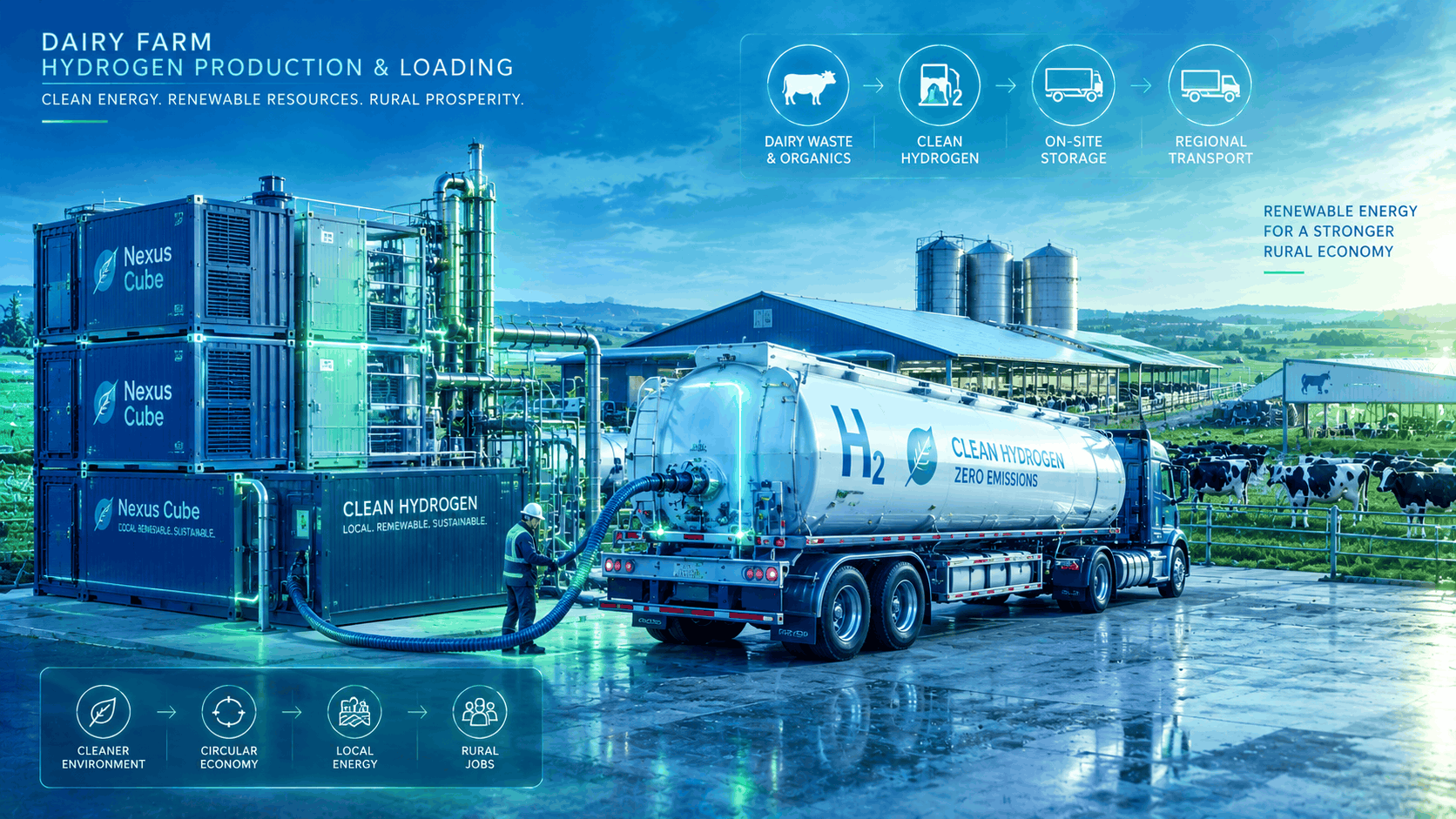
Feedstock. Waste-fed systems are paid to take their input, which inverts the cost that sinks most hydrogen projects. Anchor relationships in rendering and dairy supply the input before the plant is ever built, which means the feedstocks are perfectible as well as contracted from the outset.
The pattern behind the cancellations is that projects fail when their economics rest on conditions that someone else controls. The GH2E was designed to rest on conditions it controls, and its Track A revenue does not depend on the hydrogen assumptions in Track B.
The hydrogen transition waits for no one.
Sources and references
“Masdar shelves Abu Dhabi green hydrogen project,” MEED, 25 Aug 2026. https://guest.meed.com/masdar-shelves-abu-dhabi-green-hydrogen-project/
“Fortescue Cancels 2 Green Hydrogen Projects,” Energy Intelligence. https://www.energyintel.com/00000198-5be9-d690-a9bf-7ffdfc380000
“Oman green hydrogen projects cancelled,” MEED, 8 Dec 2025. https://guest.meed.com/oman-green-hydrogen-projects-cancelled/ (also the source of the Westwood Global Energy finding on European projects)
Envisioning, “Green Hydrogen Electrolyzer Manufacturing.” https://www.envisioning.com/research/grid/china__green-hydrogen-electrolyzer-manufacturing
“China’s Electrolyzer Cost Crash,” Energy Central. https://www.energycentral.com/energy-biz/post/china-s-electrolyzer-cost-crash----what-the-lcoh-breakdown-actually-shows-l1MezO36KAGP7tR
S&P Global, “China’s first hydrogen plan,” 2022 (Chinese Hydrogen Alliance forecast; dated, forward-looking). https://www.spglobal.com/energy/en/news-research/latest-news/energy-transition/032922-chinas-first-hydrogen-plan-focused-on-lowering-costs-building-capabilities
“Air Products announcement bad news for north country,” Yahoo News. https://www.yahoo.com/news/air-products-announcement-bad-news-231800898.html
“Oman green hydrogen projects cancelled,” MEED, 8 Dec 2025. https://guest.meed.com/oman-green-hydrogen-projects-cancelled/
Argus, “Global Hydrogen Outlook 2026.” https://view.argusmedia.com/global-hydrogen-outlook-2026.html
“US confirms early sunset for hydrogen tax credits,” H2 Tech. https://h2-tech.com/articles/2025/july-2025/hydrogen-economist/us-confirms-early-sunset-for-hydrogen-tax-credits/
Storegga Scotland project halt, SMM, 30 Jan 2026. https://news.metal.com/en/newscontent/103748526-appeal-overdue-leads-to-project-halt-uks-storegga-plans-to-sell-70-mw-green-hydrogen-project-in-scotland
“South Australia disbands Hydrogen Power office,” RenewEconomy. https://reneweconomy.com.au/south-australia-disbands-hydrogen-power-office-as-whyalla-project-officially-cancelled/
Galp 100MW electrolyser installation, gasworld hydrogen news listing. https://www.gasworld.com/topics/energy/hydrogen/?lp=80
“Analysis of China’s Hydrogen Price Trend,” SMM, 21 Aug 2026 (trade-press analysis; verify against primary price data). https://news.metal.com/newscontent/104072671-analysis-of-chinas-hydrogen-price-trend-green-hydrogen-nears-grey‐hydrogen-price-parity
Aemetis dairy digester announcement, Feedstuffs (2018 company statement). https://www.feedstuffs.com/livestock-and-poultry-market-news/aemetis-closes-on-dairy-digester-rng-equity-investment
“$1.4 billion Waste-to-Hydrogen project planned in Oman,” Oman Observer, 27 Jul 2026. https://www.omanobserver.om/article/1118111/business/energy/14-billion-waste-to-hydrogen-project-planned-in-oman
“Sharjah’s Beeah to build region’s first waste-to-hydrogen plant,” Gulf News. https://gulfnews.com/amp/gulfnews/business/energy/sharjahs-beeah-to-build-regions-first-waste-to-hydrogen-plant-with-uks-chinook-1.1646643483933