

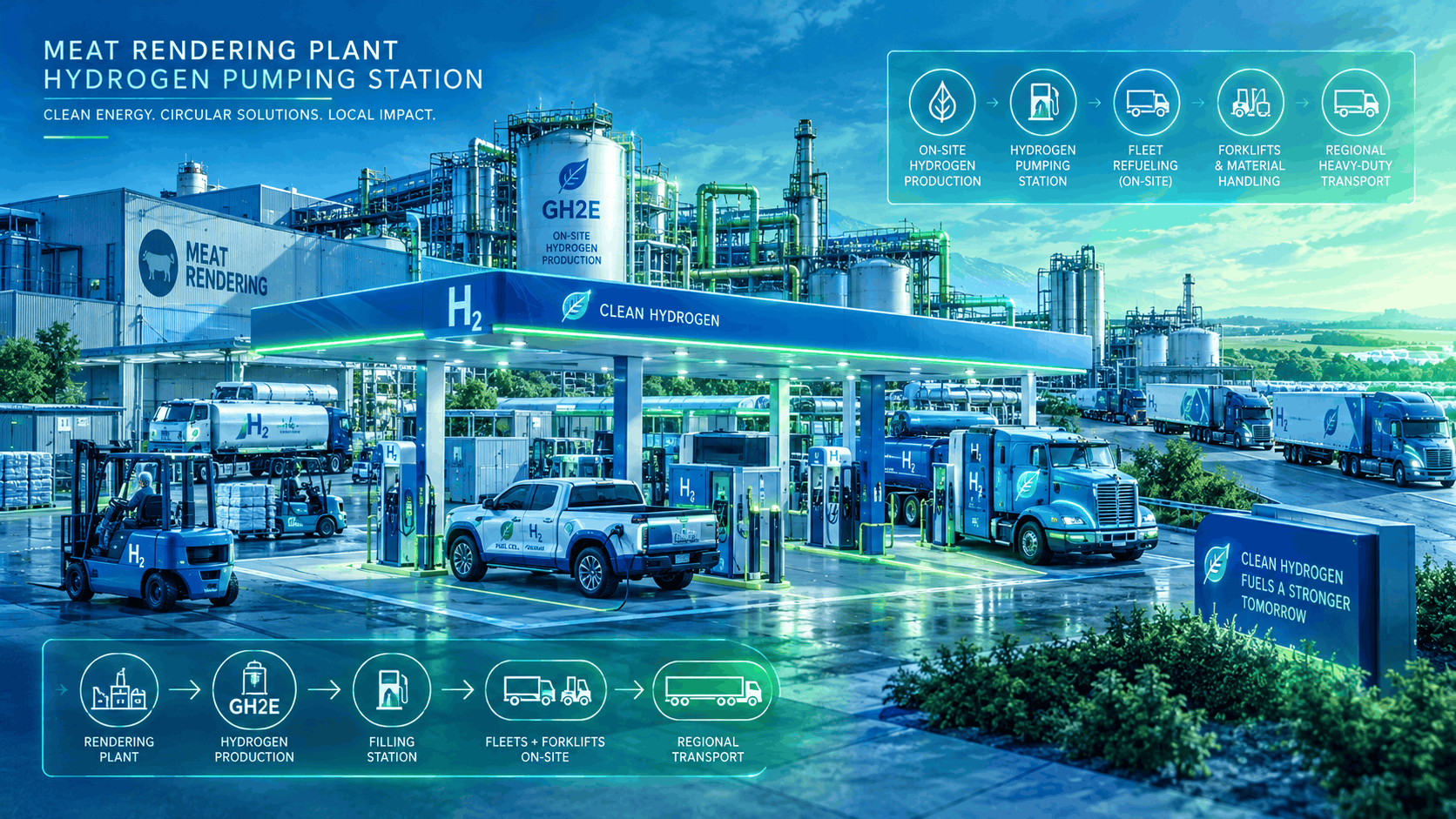
Every contribution in this series has asked what goes into the GH2E platform. This one is focused on asks happens to what comes out. A rendering or slaughterhouse plant that hosts a platform has a clear feedstock on site and a water problem on site, but it does not obviously have a hydrogen customer at the gate, and a hydrogen revenue line without a named buyer, a delivery mode — or an established revenue line. The question for a diligence reader is therefore specific: who could take hydrogen at or near the plant gate, what carbon-intensity (CI) value would that hydrogen carry for each type of vehicle or process, and what is a defensible price at the gate once the downstream costs are stripped out?
The shorter answer, developed below, with the hedging this series applies elsewhere: the fence-line case is stronger for heavy-duty, depot-based and industrial users than for light-duty zero-emission vehicles (ZEVs), because the light-duty hydrogen market in California is small, shrinking, and priced for a station network that a platform would not own. But the CI credit that heavy-duty hydrogen earns per kilogram is also smaller than the light-duty credit, and it collapses toward zero if the hydrogen’s CI is not far enough below the current regulatory ceiling. The gate price, therefore, depends less on the technology than on two things the platform hasn’t yet established: a certified CI value, and a contract that says who owns the credit.
All output figures in this article are the platform’s design targets, not from measured results. As Article Five set out, Track B yield remains contingent on characterisation work, which is part of every platform once commissioned, so every volume below it should be viewed as a nominal case that would be confirmed under certified testing conditions.
The scale and the scheme
The most useful number in this series is a comparison of two figures. A design target in the platform’s current commercial case is 125 kilograms of hydrogen per hour as a combined unit (with 8 cores). At continuous operation that is 3,000 kilograms per day, or roughly 1.05 million kilograms per year on a 350-day basis. The California Energy Commission (CEC) and Air Resources Board’s (CARB) most recent joint assessment reports that the entire state’s light-duty hydrogen stations dispensed an average of 4,224 kilograms per day in the second quarter of 2025, down about 30 percent from 5,835 kilograms per day a year earlier.1 A single platform at its target output would therefore equal roughly 71 percent of everything dispensed to every light-duty fuel cell car in California, and a ten-platform deployment of the kind contemplated for a large rendering plant would be about seven times that total.
The reason is the demand side. The same report counted 14,128 registered light-duty fuel cell vehicles in April 2025, the first recorded year-over-year decline, and used an assumption of 0.7 kilograms per vehicle per day to convert station capacity into ZEVs supported.2 On that assumption, 3,000 kilograms per day is the daily consumption of about 4,300 passenger vehicles, about three in ten of those on the road. The network has plenty of nameplate capacity; the report estimates that the existing stations could support 34,300 vehicles at the average availability observed, and projects 16,200 ZEVs by 2028 from manufacturers’ own survey responses.3 Light-duty demand is not what limits the network. It’s what limits any new supplier.
The practical conclusion is that a fence-line platform cannot be sized to the light-duty market. It has to find buyers whose consumption per vehicle is an order of magnitude larger, or buyers who are not vehicles at all.
Who could buy: five candidate offtakers
Heavy-duty trucks and drayage. This is the segment the platform’s volume actually matches. The CEC reported 139 fuel cell trucks and 113 fuel cell buses registered in California at the end of 2024, with four heavy-duty-capable stations open and 32 more planned. That appears to be a thin base, but the structure is different from light-duty: a single heavy-duty station design cited by S&P Global Commodity Insights can serve up to 200 heavy-duty trucks or 2,000 light-duty vehicles a day, which puts the heavy truck at roughly ten times the daily throughput of a car.4 Demand comes in fleet-sized increments, under contract, from a small number of buyers.
Transit and other depot fleets. Buses return to a depot, fuel on a schedule, and are bought through public funding. The CEC counts nine private transit depot stations in operation and ten planned.5 An indicative offer of $8.75 per kilogram for delivered hydrogen to California transit buses was reported to S&P Global in July 2024.6 Depot fleets are the closest analogue to the fence-line buyer, but they are public purchasers with procurement rules, and a rendering plant in the Central Valley is not necessarily near one, yet it is strategically well-placed between Oakland and Los Angeles.
Forklifts and yard equipment at the host plant. Fuel cell forklifts have been eligible for LCFS credits since the 2015 regulation, which set a forklift energy economy ratio of 2:1.7 The attraction is that the buyer is the plant itself, with no delivery leg. The limits are volume and policy: a forklift fleet consumes a tiny fraction of 3,000 kilograms per day, and CARB’s 2024 amendments cut the ratio for small electric forklifts by about 37 percent and introduced mandatory metering for forklift energy from 2026.8 It might not be verified how the amended table treats hydrogen forklifts, and a diligence file should confirm this directly before relying on the 2:1 ratio.
The host plant’s own process heat. Rendering is a heat-intensive process. Hydrogen displacing boiler fuel is not a transport use and earns no LCFS credit, but it has a well-defined floor price: natural gas parity. EIA reports California’s industrial natural gas price at $13.06 per thousand cubic feet in 2025.9 From a lower-heating-value basis, hydrogen carries about 120 megajoules per kilogram, or roughly 0.114 million British thermal units (BTUs), so at that gas price a kilogram of hydrogen is worth about $1.43 as boiler fuel (this converts gas at roughly 1.037 million BTUs per thousand cubic feet, and ignores boiler conversion cost). That is the lowest credible gate value and the one with the least counterparty risk.
Light-duty retail through a third-party station. This is the highest-priced outlet and the least suited to the platform. Hydrogen averaged $35.47 per kilogram at the pump in California in the second quarter of 2025, more than double the $14.95 average of the second quarter of 2022.10 That forecast attributes the rise to higher natural gas costs, inflation, and lower LCFS credit values, and links it to the fall in dispensing. A platform selling to a station would capture none of that retail margin, and would be selling into a falling market.
Carbon intensity by vehicle type
Under the Low Carbon Fuel Standard (LCFS), the value that should determines credit generation is not the fuel’s CI alone. It is compared within a benchmark after the fuel’s CI has been adjusted for how efficiently a vehicle uses it, through an energy economy ratio. For hydrogen, CARB’s ratio is 2.5 for light-duty ZEVs and 1.9 for the heavy-duty vehicle fleets.11 Another way to explain this: the fuel cell car is treated as 2.5 times as efficient as the gasoline car it displaces, and the heavy fuel cell truck as 1.9 times as efficient as the diesel truck.
The 2026 benchmarks, after the amendments which took effect in July 2025, are 75.16 grams of carbon dioxide equivalent per megajoule for gasoline and 80.17 for diesel.12 The ratio is applied to the benchmark, and hydrogen’s own certified carbon intensity is subtracted from the result. The table above applies that arithmetic to an illustrative set of CI values at the most recent credit price that could be retrieved, or the volume-weighted average of $69.07 per tonne for the week of 6 to 12 July 2026.13 It uses 120 megajoules per kilogram of hydrogen. The CI values in the left column are illustrations of the arithmetic, not estimates for GH2E, whose value has not been modelled before a reasonable commissioning stage.
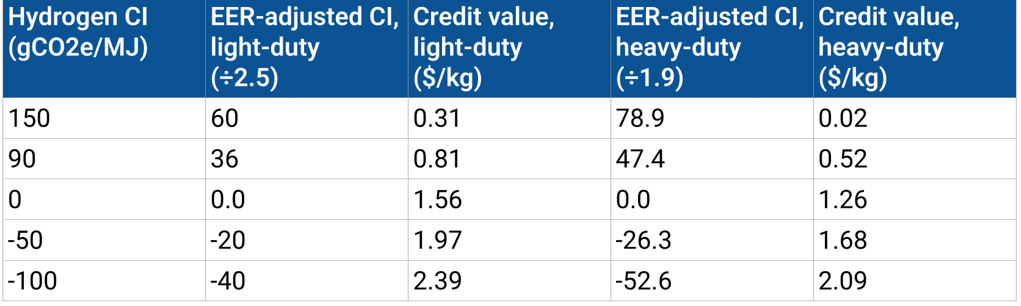
Three immediate observations follow. First, the 150 and 90 rows aren’t arbitrary. They are the company-wide ceilings that CARB’s amended rules set for dispensed hydrogen to remain eligible for credit before and after 1 January 2030, alongside the renewable-content floors of 40 and 80 percent, respectively.14 Any pathway sitting at the ceiling earns almost nothing from each heavy-duty truck, and the credit becomes meaningful only well below it. Second, the heavy-duty credit per kilogram is lower than the light-duty credit at every CI value, because the lower efficiency ratio gives hydrogen a lesser advantage over the diesel it displaces. The fleet that matches the platform’s volume is the one that earns less per kilogram. Third, even at a CI of zero, the credit is near the order of $1.26 to $1.56 per kilogram at current prices, which is material up against a process-heat floor of $1.43 but small against any delivered-price scenario in the next section. The credit supplements a gate price; it does not create one.
What carbon intensity the platform could actually certify is unresolved, and the article should not suggest otherwise. Two points are worth stating. CARB’s glossary-level definition of renewable hydrogen includes hydrogen from thermochemical conversion of biomass,15 and the platform converts organic waste thermochemically, but whether animal-processing residues such as paunch fall inside that definition, and which life-cycle accounting applies, is a question for CARB and not something which this series will assume. And the amended rules apply CA-GREET 4.0 to new pathway applications, with a four-times credit removal when verified carbon intensity exceeds the posted value beyond a margin of safety.16 That penalty makes an optimistic certified value a liability. The one published comparison point from a similar technology, a plasma-based hydrogen developer in California that told CARB in 2021 it expected a value of −188 grams per megajoule for a biogenic-waste feedstock, is the developer’s own estimate and is not certified, and it should not be read as a benchmark for GH2E.17
Gate price: working down from the delivered price
A gate price is not observed anywhere. Public sources report prices at the dispenser or delivered to a depot, so gate value has to be derived by subtracting the costs between the plant and the buyer. The derivation below uses the sourced figures available and states where a leg is missing.
Start with what most heavy-duty buyers appear willing to pay. S&P Global Commodity Insights reported in 2024 that hydrogen for heavy-duty trucks in California was priced at $7 to $15 per kilogram, with a modelled willingness to pay for trucking of $10.60 to $11.30 per kilogram, and the Department of Energy’s (DOE’s) first target for dispensed heavy-duty hydrogen remains $7 per kilogram by 2028.18 Those figures are dispensed or delivered prices and included the cost of the station.
Now subtract the station: A University of California modelling report estimates a base station markup of $2.50-$4.00 per kilogram above the price for hydrogen production and delivery to the station, with higher markups when utilisation is low, and reports a production-and-delivery range of $5 to $8 per kilogram.19 Subtracting the markup from the willingness-to-pay range gives an implied production-and-delivery price of roughly $6.60 to $8.80 per kilogram. For a platform that owns or hosts the dispensing point at its own fence, the delivery leg shrinks toward zero, and the implied gate value approaches an upper end of that range. More recently sourced figures for the delivery leg itself have not shifted, so the gate band below should be read as an upper bound for a co-located case, not as an expected price.
Next, set that range against the competition and the floor. The real cost of electrolytic hydrogen in California under 2019 conditions, in a theoretical grid-connected case, was estimated at about $3 per kilogram in an NREL report, with a least-cost scenario of $4.70 per kilogram in one utility territory.20 These were old models, and they came in below the $5 to $8 range for delivered hydrogen, which is consistent with delivery and station costs, explaining much of the delivered price. Since then, federal support has also narrowed: the 45V clean hydrogen production credit applies only to facilities that begin construction before 1 January 2028,21 the Department of Energy cancelled all seven regional hydrogen hubs in September 2025 including California’s, and the California hub paused its activities that November. A platform that depends on federal production credits would need to be under construction within that window.
The most significant note from this case is that the GH2E is insulated against this loss of subsidy, as the model was never dependent on them in the first place. The result is a three-tier picture, presented as scenarios and not forecasts.
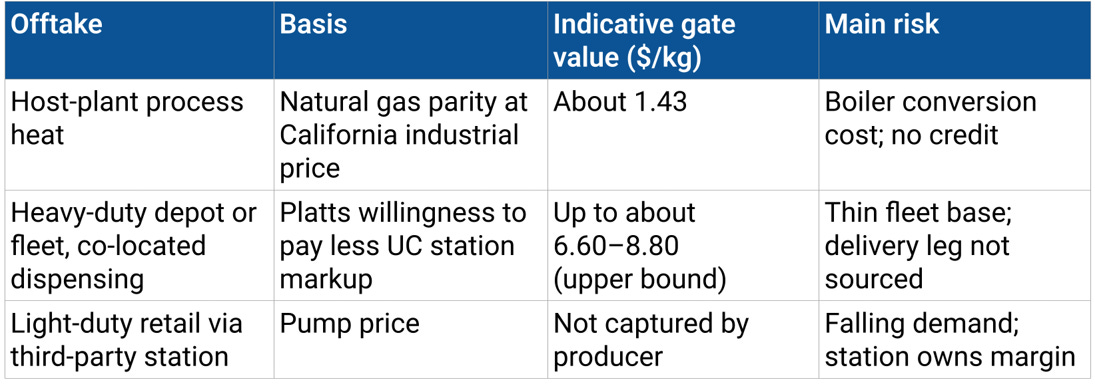
An LCFS credit is additional to each row only if the contract assigns it to the producer. CARB's own materials describe the station owner as a default credit generator for the hydrogen dispensed as transportation fuel,22 so any platform selling hydrogen at its gate to a third-party station should find that the credit sits with the buyer. That is a contract term, and the contract is where a large share of the platform's CI value would be won or lost.
Credit price risk
The credit itself is a volatile input. The volume-weighted average price was $69.07 per tonne in the week of 6 to 12 July 2026, within a weekly range of $54.25 to $100.00,23 just as Argus reported that credits had fallen as low as $40 per tonne in 2025 before recovering, with December 2026 futures trading as high as $72.24 CARB’s price ceiling was set at $268.90 per tonne for June 2025 to May 2026.25 The CEC report says that the credit price fell from about $200 when its 2019 solicitation was issued to roughly $48 by June 2025, and that two station developers were waiting for a recovery before building. Credits don’t expire, and the oversupply that depressed the price has been addressed by the amendments, but the table above moves in proportion to the price, so a platform whose case needs the credit at current levels should show the case at $40 as well.
Where this leaves the fence-line case
The offtake question has a narrower answer than the technology narrative suggests. A platform at its target output produces more hydrogen than the state’s light-duty fleet consumes, so it needs heavy-duty fleets, depot buyers, or its own process heat. Prices that it can realistically capture at the gate which trend from about $1.43 per kilogram, the natural gas floor, to a heavy-duty upper bound of roughly $6.60 to $8.80 per kilo-gram. That needs a co-located dispensing point, a contracted fleet, or a credit-owner- ship clause that the producer does not yet have. The LCFS credit adds about $0.50 to $2 per kilogram for heavy-duty use across the CI values that a certified pathway might plausibly reach, but only if the hydrogen qualifies, only if a producer holds the credits, and only if the CI value survives verification.
What would settle it is short and specific: a certified or at least CARB-reviewed carbon-intensity estimate for waste-derived hydrogen from a given feedstock; a named heavy-duty or depot counterparty with a letter of intent and a price basis; a delivery-leg cost for the plant’s actual location. An answer from CARB as to whether animal-processing residue counts as biomass under the renewable hydrogen definition. None of these has been obtained here. Until they are, the sound posture for a diligence reader is to underwrite the process-heat floor as the only revenue line with a source behind it and to treat everything above it as an option with a defined cost of exercise.
Why the base case doesn’t need the state
In summary, every other piece of the energy transition leans on something outside the project: a grid connection, a grant, a production tax credit, a hub award. The hydrogen hubs were cancelled and the 45V credit has a construction deadline, which shows how fragile that dependence can be.2627 But the GH2E is built differently. It makes its own power, so it needs no grid. Its base case, which rests on Track A treatment-as-a-service and on hydrogen valued no higher than the natural gas floor, requires no grants, no tax credits and no credit-market price to hold. The LCFS credit, the heavy-duty price premium, and any federal support are upside to that base case, not premises of it. The base case has been held constant since the first document in this series and what each article has added is disclosed risk or disclosed upside, never a revised foundation.
That combination, with no grid, no grants, no subsidy dependence and a base case that has not moved, is the strongest argument that GH2E is the best bet in the transition. The platform economics that Article Five describes is what turns these arguments from a position into evidence.
Sources and references
California Energy Commission and California Air Resources Board, Joint Agency Staff Report on Assembly Bill 126: 2025 Annual Assessment of the Hydrogen Refueling Network in California, CEC-600-2026-022 (December 2025): https://www.energy.ca.gov/sites/default/files/2026-05/CEC-600-2026-022.pdf
Ibid.
Ibid.
S&P Global Commodity Insights, "California's hydrogen mobility market evolves into heavy-duty applications" (July 2024): https://www.spglobal.com/commodityinsights/en/market-insights/latest-news/energy-transition/073024-californias-hydrogen-mobility-market-evolves-into-heavy-duty-applications
California Energy Commission and California Air Resources Board, Joint Agency Staff Report on Assembly Bill 126: 2025 Annual Assessment of the Hydrogen Refueling Network in California, CEC-600-2026-022 (December 2025): https://www.energy.ca.gov/sites/default/files/2026-05/CEC-600-2026-022.pdf
S&P Global Commodity Insights, "California's hydrogen mobility market evolves into heavy-duty applications" (July 2024): https://www.spglobal.com/commodityinsights/en/market-insights/latest-news/energy-transition/073024-californias-hydrogen-mobility-market-evolves-into-heavy-duty-applications
California Air Resources Board, Updated Informative Digest, Regulation to Implement the California Low Carbon Fuel Standard (2015) (hydrogen fuel cell forklift EER of 2.1): https://ww2.arb.ca.gov/sites/default/files/barcu/regact/2015/lcfs2015/uidlcfs.pdf
SRECTrade, "CARB approves major updates to strengthen the LCFS Program" (November 2024): https://www.srectrade.com/blog/?p=12180
U.S. Energy Information Administration, California Natural Gas Industrial Price (annual): https://www.eia.gov/DNAV/NG/hist/n3035ca3A.htm
California Energy Commission and California Air Resources Board, Joint Agency Staff Report on Assembly Bill 126: 2025 Annual Assessment of the Hydrogen Refueling Network in California, CEC-600-2026-022 (December 2025): https://www.energy.ca.gov/sites/default/files/2026-05/CEC-600-2026-022.pdf
Yachun Chow, California Air Resources Board, "Low Carbon Fuel Standard Regulation and Hydrogen" (presentation, 2023) (EER values of 2.5 light-duty and 1.9 heavy-duty fuel cell vehicles; station owner as default credit generator): https://calact.org/wp-content/uploads/2023/05/Low-Carbon-Fuel-Standard-Regulation-and-Hydrogen-Yachun-Chow.pdf
Argus Media, "California LCFS credit shrink lifts prices: Update": https://www.argusmedia.com/en/news-and-insights/latest-market-news/2783116-california-lcfs-credit-shrink-lifts-prices-update
California Air Resources Board, Weekly LCFS Credit Transfer Activity Reports (week of 6–12 July 2026): https://ww2.arb.ca.gov/resources/documents/weekly-lcfs-credit-transfer-activity-reports
Trinity Consultants, “California LCFS Compliance in 2026 – 9 Key Questions About the Updated Requirements” (26 February 2026) (2026 benchmarks, hydrogen CI and renewable-content thresholds, CA-GREET 4.0, 4× credit removal): https://trinityconsultants.com/resources/california-lcfs-compliance-in-2026-9-key-questions-about-the-updated-requirements/
California Energy Commission and California Air Resources Board, Joint Agency Staff Report on Assembly Bill 126: 2025 Annual Assessment of the Hydrogen Refueling Network in California, CEC-600-2026-022 (December 2025): https://www.energy.ca.gov/sites/default/files/2026-05/CEC-600-2026-022.pdf
Trinity Consultants, “California LCFS Compliance in 2026 – 9 Key Questions About the Updated Requirements” (26 February 2026) (2026 benchmarks, hydrogen CI and renewable-content thresholds, CA-GREET 4.0, 4× credit removal): https://trinityconsultants.com/resources/california-lcfs-compliance-in-2026-9-key-questions-about-the-updated-requirements/
SGH2 Energy Global LLC, comments to CARB LCFS workshop (December 2021) (developer’s own estimate; not a certified value): https://www.arb.ca.gov/lists/com-attach/12-lcfs-wkshp-dec21-ws-UTIBaAZqAjwFZgRq.docx
S&P Global Commodity Insights, “California’s hydrogen mobility market evolves into heavy-duty applications” (July 2024): https://www.spglobal.com/commodityinsights/en/market-insights/latest-news/energy-transition/073024-californias-hydrogen-mobility-market-evolves-into-heavy-duty-applications
University of California, California FCEV and Hydrogen Refueling Station Deployment: Requirements and Costs to Meet Targets (Hydrogen Modeling Report, UC Davis): https://dermatology.cdlib.org/content/qt97s439v1/qt97s439v1.pdf?t=scpjma
National Renewable Energy Laboratory, Integrating Hydrogen Production and Electricity Markets: Analytical Insights from California (2022): https://www.nrel.gov/docs/fy22osti/80902.pdf
H2 Tech, “US confirms early sunset for hydrogen tax credits” (July 2025): https://h2-tech.com/articles/2025/july-2025/hydrogen-economist/us-confirms-early-sunset-for-hydrogen-tax-credits/
Yachun Chow, California Air Resources Board, “Low Carbon Fuel Standard Regulation and Hydrogen” (presentation, 2023) (EER values of 2.5 light-duty and 1.9 heavy-duty fuel cell vehicles; station owner as default credit generator): https://calact.org/wp-content/uploads/2023/05/Low-Carbon-Fuel-Standard-Regulation-and-Hydrogen-Yachun-Chow.pdf
California Air Resources Board, Weekly LCFS Credit Transfer Activity Reports (week of 6–12 July 2026): https://ww2.arb.ca.gov/resources/documents/weekly-lcfs-credit-transfer-activity-reports
Argus Media, “California LCFS credit shrink lifts prices: Update”: https://www.argusmedia.com/en/news-and-insights/latest-market-news/2783116-california-lcfs-credit-shrink-lifts-prices-update
Sylvera, “LCFS credit price: what drives it, where it is going” (1 May 2026) (price ceiling of $268.90 per tonne, June 2025–May 2026): https://www.sylvera.com/es/blog/lcfs-credit-price
California Energy Commission and California Air Resources Board, Joint Agency Staff Report on Assembly Bill 126: 2025 Annual Assessment of the Hydrogen Refueling Network in California, CEC-600-2026-022 (December 2025): https://www.energy.ca.gov/sites/default/files/2026-05/CEC-600-2026-022.pdf
H2 Tech, “US confirms early sunset for hydrogen tax credits” (July 2025): https://h2-tech.com/articles/2025/july-2025/hydrogen-economist/us-confirms-early-sunset-for-hydrogen-tax-credits/