

By Lily Kim, Senior Technology Analyst, NexusInnovest
BELGIUM — European Hydrogen Week opens in Brussels on October 26th, just as the market finds itself at an awkward moment. Subsidy rounds are oversubscribed, yet few projects hold the offtake contracts that a lender would underwrite. This piece sets out what the week’s policy conference is sure to cover, what it’s likely to produce, what it means beyond Europe, and what markets should want to see happen.
The short answer, developed below with the same hedging this publication applies elsewhere: the central position is that Brussels could do one thing this month which matters more than any new target, which is to turn oversubscribed subsidy issuances into offtakes that a lender will underwrite. Several gaps remain unresolved, including who the keynote speakers are, and they are disclosed here rather than smoothed over conveniently.
What the policy conference will cover
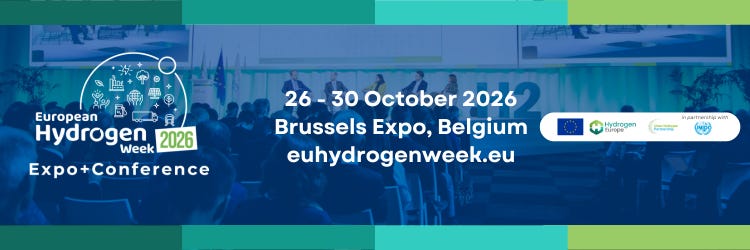
The week runs October 26 to 30 at Brussels Expo under the banner “Scaling Hydrogen, Strengthening Resilience.”1 The European Commission (EC), Hydrogen Europe and the Clean Hydrogen Partnership co-organise it, with UNIDO as a partner.2
The High-Level Policy Conference runs October 26 to 28 and places policymakers, C-level executives and value-chain experts on one stage to discuss global, European and national developments. The organisers promise more than 20 sessions and over 200 speakers across the week.3 The EU Hydrogen Innovation Forum follows on October 27 and 28, with a competitiveness theme and sessions on start-ups, skills, Hydrogen Valleys and how EU, national and regional funding fit together.4
The published programme is thin on session-level detail, so the following five threads are an inference from the programme and the live policy files rather than a confirmed agenda:
The renewable hydrogen rulebook. The Commission has said it will propose a targeted review of the Renewable Fuels of Non-Biological Origin (RFNBO) rules ahead of the 2028 schedule, with additionality and temporal matching as the key flashpoints.5
Low-carbon hydrogen. The low-carbon delegated act has entered into force on November 21, 2025, and industry is now asking how this will sit beside renewable hydrogen in funding and mandates.6
Money. The Hydrogen Bank’s third auction awarded €1.09 billion to 9 projects,7 and a fourth auction with a €500 million budget is planned before year-end.8
Demand and offtake. The EU Hydrogen Mechanism is designed to connect the producers with credible EU offtakers, yet producers still describe demand as the binding constraint.9
Resilience. The theme is in the title for a reason. The third auction has tightened resilience criteria aimed at Chinese electrolyser equipment, and that key debate is likely to continue on stage.10
What Analysts want to see happen
The wish list is an analyst’s view, and not a forecast. Each item is framed as something a minister or a lender could act on.
A narrow, fast RFNBO review. Operators want the legal uncertainty and genuine cost drivers fixed, and then the process closed. Vattenfall has argued for a strictly targeted revision because projects already made investment decisions based on the current rules.11 A joint letter from environmental groups argues the opposite, that additionality is an essential guardrail.12 The Commission has said the review will safeguard existing investments, and stakeholders likely want to see that very promise made specific on stage.
A fifth Hydrogen Bank round, announced. The third auction was thoroughly oversubscribed more than six times, and the lowest bid came in at €0.44 per kilogram.13 A more visible multi-year pipeline of auctions lets developers resume planning.
Demand that is enforced rather than aspirational. Hydrogen Europe wants the Bank to accompany implementation of the Renewable Energy Directive’s industry and transport requirements.14 Member states should be prepared to identify their transposition dates in public.
Pipes and grids on a timetable. Supply without transport is a stranded asset. A consultation on a 400 km France-Spain subsea hydrogen pipeline was launched in May. This would be a good start, but the industry wants more corridors announced with dates attached.
Equal treatment for every credible molecule. Germany has moved to back low-carbon hydrogen alongside renewable hydrogen.15 Europe needs to back carbon intensity and verified lifecycle emissions, not on which pathway lobbied hardest.
Likely outcomes and how the momentum might be shaped
Conferences rarely decide policy. But they signal it. The signals below are those which are most probable, with the confidence of each marked.
Likely, with the usual hedging
A softer RFNBO signal. One analyst report expects the Commission to propose delaying the additionality phase-in from 2028 to roughly 2032 or 2033.16 That is a single forecast, not a decision. Expect the hallway discussion to centre more on grandfathering and legal certainty.
A technology-neutral tilt. The same analysis sees the Commission moving away from prescriptive green hydrogen targets toward support for both renewable and low-carbon hydrogen. View this as a probable direction rather than a settled fact.
Bank follow-through. Grant agreements for the third auction are expected in the fourth quarter of 2026,* and the fourth auction’s €500 million budget was already announced in July.17
Positive momentum that should be hard to miss
Competitive bidding. The third auction drew 58 bids from 11 countries and it has awarded €1.09 billion to nine projects.18 That is a recovery from a second round that secured only 380 MW.19
National money on top. Spain and Germany made a further €1.7 billion available through the Bank’s auction-as-a-service route.20
A visible offtake pipeline. The Commission’s matchmaking exercise registered 265 supply opportunities, including 47 ammonia and 37 methanol projects.21
Aviation and shipping. The Commission has said it will step up support for synthetic aviation and marine fuels,22 and the Bank’s third basket already targeted those offtakers.23
The counterweight is quite sobering. Europe had 333 MW of electrolytic hydrogen in operation at the end of 2025, and offtake uncertainty remains the primary constraint on investment.24 European electrolyser factories are underused because demand has not yet arrived.25 That momentum is real, and so is the gap.
Global impacts
What Brussels decides does not stay in Brussels. European rules will set the terms for anyone who wants to sell hydrogen or its derivatives into the region, which covers a large number of projects abroad.
Import dependence is the open question. A 2026 modelling study found that meeting projected 2030 RFNBO demand would need approximately 92.5 GW of electrolysers, against roughly 67 GW targeted by member states, and estimates that imports would supply 30 to 62 percent of EU demand across its scenarios.26 These are scenarios, not forecasts or predictions.
Export-led projects feel every delay. Wood Mackenzie has noted that export-oriented regions have been affected by ongoing European policy delays such as the transposition of the Renewable Energy Directive, and it fully expects Middle Eastern hydrogen plans to retreat.27 A clearer rulebook in Brussels is worth more to those developers than another subsidy.
The China question. The World Bank puts China at 86 percent of global alkaline electrolyser capacity, as cited by industry press.28 The Bank’s third auction has tightened its resilience criteria aimed at Chinese equipment.29 How far that goes is likely to be a live debate on stage.
Developing-economy access. With UNIDO as a partner,30 observers now hope that the week gives real airtime to how emerging markets supply and consume hydrogen without being priced out by compliance costs. Airspace for modular, autonomous hydrogen systems is deserved, and with that a debate on platform designs for reused water is long overdue.
The conclusion here is that Europe is deciding whether hydrogen becomes a regional industrial policy or a traded commodity. Germany, France, the Netherlands, Norway, Japan and the United States are among the countries listed as represented, and each will be listening closely for that answer.31
Other considerations worth exploring
The published agenda is built around electrons and electrolysers. Operators outside of this narrow view, have identified four questions which deserve more airtime than they will probably get.
Feedstock, not just power. Electrolysis is one route to hydrogen. Hydrogen from waste streams is another, and it turns a disposal cost into a revenue line. Waste is the new crude, in the thesis this publication has advanced throughout, and policy frameworks that count only electrolytic molecules leaves that value on the table. The industry needs a speaker to ask how waste-derived hydrogen is classified and supported. No evidence was found in the published programme that this is going to be addressed, which is itself a finding.
Who carries the offtake risk? Subsidy closes the gap between production costs and market price, but it does not create a buyer. One market analysis calls offtake uncertainty the primary constraint on investment.32 Until a lender sees a contract, a pipeline remains a pipeline.
Rule stability vs rule flexibility. Loosening the rules helps projects that cannot yet comply, and it could penalise those that already did. Both camps have a fair point, and the review has to answer to both.
Water. Every kilogram of electrolytic hydrogen needs a water source. Sitting in a drought-exposed region has become a critical matter, so municipal and industrial water partnerships belong in this conversation. This point is a conclusion derived from conference materials and is not drawn from the actual programme.
In the meantime, fuel is freedom. A continent that makes more of its own energy from what it already throws away is much harder to pressure. This resilience angle would be worth hearing and most welcome in the conference auditorium.
Where this leaves the week
The talking points assembled here supports a clearer view of what the conference will debate, but not an unqualified view of what it will decide. The dates, organisers, stage analysis and broad policy files are documented. The momentum from auction demand and national funding is documented too.
What isn’t established is a session-level agenda, the keynote lineup, the Commission’s actual RFNBO proposal, and whether offtakes will follow subsidy. Forecasts attributed to analyst firms are single-source and should not be represented to a diligence reader as consensus. What exists is a wish list from a specific point of view, and this topic will be revisited once the week has produced something to test it against.
Sources and references
Clean Hydrogen Partnership, “European Hydrogen Week 2026”: https://www.clean-hydrogen.europa.eu/european-hydrogen-week/european-hydrogen-week-2026_en
European Hydrogen Week, “EUH2Week2026 Speakers Promo Toolkit” (co-organisers and UNIDO partnership): https://euhydrogenweek.eu/wp-content/uploads/2026/07/EUH2Week2026_PromoToolkit_Speakers.pdf
European Hydrogen Week, “Programme overview”: https://euhydrogenweek.eu/programme-overview/
Clean Hydrogen Partnership, “EU Hydrogen Innovation Forum 2026: from innovation to impact” (July 7, 2026): https://www.clean-hydrogen.europa.eu/media/news/eu-hydrogen-innovation-forum-2026-innovation-impact-2026-07-07_en
Argus Media, “EU confirms early green H2 rules review, e-fuel support”: https://www.argusmedia.com/en/news-and-insights/latest-market-news/2817431-eu-confirms-early-green-h2-rules-review-e-fuel-support
Capstone, “The European Commission’s Hydrogen Pivot”: https://capstonedc.com/?p=54410
Hydrogen Europe, “High levels of competition in 3rd EU Hydrogen Bank auction”: https://hydrogeneurope.eu/high-levels-of-competition-in-3rd-eu-hydrogen-bank-auction/
Hydronews, “Brussels has allocated 500 million euros for the fourth auction of the European Hydrogen Bank” (July 10, 2026): https://www.hydronews.it/en/brussels-has-allocated-500-million-euros-for-the-fourth-auction-of-the-european-hydrogen-bank/
Westwood Energy, “Hydrogen Compass, December 2025”: https://www.westwoodenergy.com/sectors/energy-transition/hydrogen/hydrogen-compass-december-2025
Czech energy portal, “Fewer bidders, more money. Third EU hydrogen auction to distribute €1.1 billion” (May 22, 2026): https://oenergetice.cz/en/hydrogen/fewer-bidders-more-money-third-eu-hydrogen-auction-to-distribute-1-1-billion
Vattenfall, “Views on the upcoming targeted RFNBO revision”: https://group.vattenfall.com/siteassets/corporate/who-we-are/public-affairs/vattenfall-views-upcoming-targeted-rfnbo-revision.pdf
Transport & Environment and others, “Joint letter on RFNBO” (February 18, 2026): https://www.transportenvironment.org/uploads/files/20260218_TE_Joint-Letter-on-RFNBO.pdf
pv magazine, “EU allocates 1.1 GW of electrolyser capacity in third hydrogen auction, lowest bid comes in at €0.44/kg” (May 7, 2026): https://www.pv-magazine.com/2026/05/07/eu-allocates-1-1-gw-of-electrolyzer-capacity-in-third-hydrogen-auction-lowest-bid-comes-in-at-e0-44-kg/
Hydrogen Europe, “High levels of competition in 3rd EU Hydrogen Bank auction”: https://hydrogeneurope.eu/high-levels-of-competition-in-3rd-eu-hydrogen-bank-auction/
Global e-Fuels via Advanced Biofuels USA, “EU to Accelerate Renewable Hydrogen Review”: https://advancedbiofuelsusa.info/eu-to-accelerate-renewable-hydrogen-review
Capstone, “The European Commission’s Hydrogen Pivot”: https://capstonedc.com/?p=54410
Hydronews, “Brussels has allocated 500 million euros for the fourth auction of the European Hydrogen Bank” (July 10, 2026): https://www.hydronews.it/en/brussels-has-allocated-500-million-euros-for-the-fourth-auction-of-the-european-hydrogen-bank/
pv magazine, “EU allocates 1.1 GW of electrolyser capacity in third hydrogen auction, lowest bid comes in at €0.44/kg” (May 7, 2026): https://www.pv-magazine.com/2026/05/07/eu-allocates-1-1-gw-of-electrolyzer-capacity-in-third-hydrogen-auction-lowest-bid-comes-in-at-e0-44-kg/
&P Global, “EU third hydrogen bank awards €1.1 bil for 1.1 GW electrolysis” (May 7, 2026): https://www.spglobal.com/energy/en/news-research/latest-news/energy-transition/050726-eu-third-hydrogen-bank-awards-eur11-bil-for-11-gw-electrolysis
S&P Global, “EU third hydrogen bank awards €1.1 bil for 1.1 GW electrolysis” (May 7, 2026): https://www.spglobal.com/energy/en/news-research/latest-news/energy-transition/050726-eu-third-hydrogen-bank-awards-eur11-bil-for-11-gw-electrolysis
Global e-Fuels via Advanced Biofuels USA, “EU to Accelerate Renewable Hydrogen Review”: https://advancedbiofuelsusa.info/eu-to-accelerate-renewable-hydrogen-review
Argus Media, “EU confirms early green H2 rules review, e-fuel support”: https://www.argusmedia.com/en/news-and-insights/latest-market-news/2817431-eu-confirms-early-green-h2-rules-review-e-fuel-support
Hydrogen Europe, “High levels of competition in 3rd EU Hydrogen Bank auction”: https://hydrogeneurope.eu/high-levels-of-competition-in-3rd-eu-hydrogen-bank-auction/
Westwood Energy, “Hydrogen Compass, January 2026”: https://www.westwoodenergy.com/sectors/energy-transition/hydrogen/hydrogen-compass-january-2026
gasworld, “Stalled European hydrogen demand leaves electrolyser factories underused: EIC”: https://www.gasworld.com/story/stalled-european-hydrogen-demand-leaves-electrolyser-factories-underused-eic/2257107.article/
“Scaling Green Hydrogen in Europe: who’s ready?” (2026), CNR institutional repository: https://iris.cnr.it/handle/20.500.14243/590821
pv magazine Australia, “Hydrogen faces ‘year of reckoning’ in 2026, says Wood Mackenzie”: https://www.pv-magazine-australia.com/?p=15157
gasworld, “Stalled European hydrogen demand leaves electrolyser factories underused: EIC”: https://www.gasworld.com/story/stalled-european-hydrogen-demand-leaves-electrolyser-factories-underused-eic/2257107.article/
Czech energy portal, “Fewer bidders, more money. Third EU hydrogen auction to distribute €1.1 billion” (May 22, 2026): https://oenergetice.cz/en/hydrogen/fewer-bidders-more-money-third-eu-hydrogen-auction-to-distribute-1-1-billion
European Hydrogen Week, “EUH2Week2026 Speakers Promo Toolkit” (co-organisers and UNIDO partnership): https://euhydrogenweek.eu/wp-content/uploads/2026/07/EUH2Week2026_PromoToolkit_Speakers.pdf
Event listing, “European Hydrogen Week 2026” (countries represented): https://www.mondaymerch.com/uk/exhibitions/european-hydrogen-week-2026
Westwood Energy, “Hydrogen Compass, January 2026”: https://www.westwoodenergy.com/sectors/energy-transition/hydrogen/hydrogen-compass-january-2026