

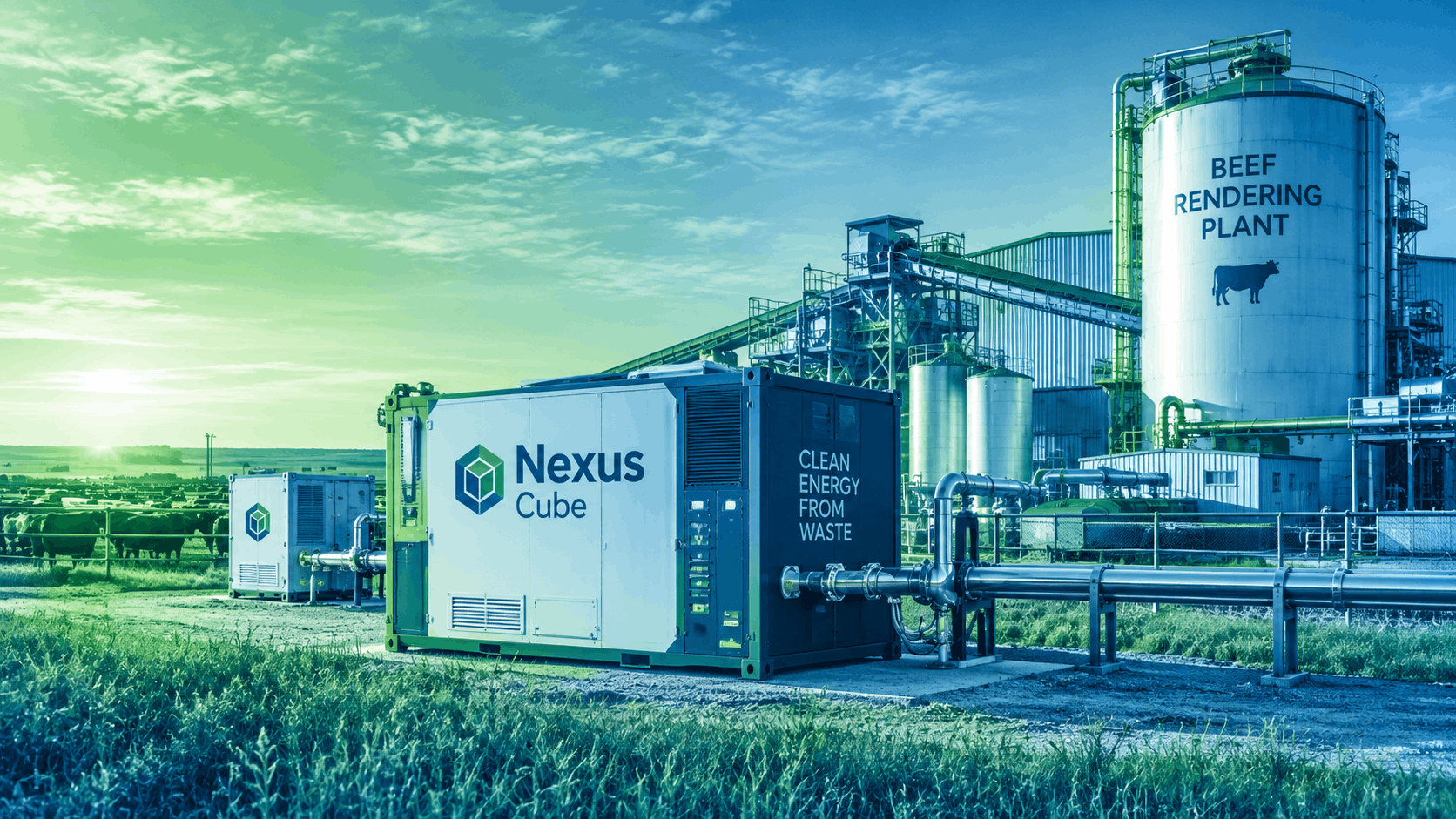
Every technology thesis built on a single feedstock carries a structural objection: what happens if a feedstock’s economics, regulatory treatment, or availability change? For the GH2E platform, that objection has so far been aimed at the formula for a carbon- negative dairy. This article runs along the same underwriting discipline used elsewhere in this series against a second, adjacent feedstock class — the waste streams found in meatpacking, slaughterhouse, and rendering operations — to test whether the thesis stands on its own outside a single livestock vertical.
The short answer, developed below with the same hedging that this series has applied everywhere else: the rendering and slaughterhouse stream is much larger, dirtier, and in many respects far more commercially exposed than dairy manure, which makes it a genuinely different — not merely adjacent — feedstock case. It also brings to light a live regulatory reversal that changes the underwriting math in ways a diligence reader should see clearly rather than have smoothed over.
Sizing the stream
Meat and poultry processing plants are, by volume, among the most water-intensive and highest industrial dischargers in the United States. A widely used industry guide- line places water consumption at roughly 5 litres per kilogram of animal processed, increasing to 5–10 litres per kilogram for poultry.1 A 2021 USDA Food Safety and Inspection Service advisory committee report views the sector’s footprint in broader terms: meat processing can account for up to 24% of freshwater consumption across the entire food and beverage industry, and cites Australian beef-plant data showing 3.8 to 17.9 kilolitres of water used per tonne of carcass weight produced — a roughly four-fold spread driven by plant design and water-reuse practices already in place at the more efficient end.2
That same report profiles Harmony Beef in Calgary, Alberta as the very first processing plant in North America to reprocess its wastewater: a multi-stage electrocoagulation, biological, membrane, and reverse-osmosis train that recycles better than 90% of daily water needs, with only 7% of process water ultimately sent to sewer. That is a directly relevant existing proof point for the Dimension Water™ half of the GH2E Cube’s pitch — an operating beef plant, not just a pilot, already running electrocoagulation as one stage of a near-closed-loop water system.
What comes back out is the problem. Slaughterhouse wastewater (SWW) carries high biochemical oxygen demand (BOD), chemical oxygen demand (COD), total suspended solids, and both nitrogen and phosphorus loads, driven by blood, fats, proteins, and fecal material entrained in the process water.3 Blood alone — even before dilution — has been measured at a COD of approximately 375,000 mg/L, which is several orders of magnitude above typical municipal wastewater.4 This is, in the vocabulary that this series has used elsewhere in its biochemical analysis, a high-BOD stream in the truest sense: concentrated, biologically reactive, and expensive to treat.
The scale of the discharge problem isn’t hypothetical. EPA data compiled by advocacy researchers found that U.S. slaughterhouses released more than 28 million pounds of nitrogen and phosphorus directly into rivers and streams in 2019 alone.5 At the food production level, the worst dischargers are not marginal operations: an Environmental Integrity Project analysis found that Smithfield Foods’ John Morrell plant in Sioux Falls released 866,874 pounds of nitrogen during 2022 and 2023, with Smithfield’s Tarheel, North Carolina plant close behind at 773,553 pounds over the same period — both more than six times the industry average.6 These are large, well-capitalised, publicly known operators, not distressed small individual processors, which matters greatly to a diligence audience assessing counterparty risk versus opportunity.
The regulatory reversal that alters the frame
Any article which leans on regulatory pressure as a demand driver owes the reader an honest account of where that pressure currently stands — because here the picture is now cutting one of two ways. In January 2024, the EPA proposed to revise the Effluent Limitations Guidelines (ELGs) for the Meat and Poultry Products point source category for the first time in two decades, with a preferred option that would have applied new nitrogen, phosphorus, and pretreatment standards to hundreds of direct- and indirect-discharging facilities.7
That proposal didn’t survive. On August 28, 2025, EPA Administrator Lee Zeldin signed a final action withdrawing the proposed rule entirely, and on September 3, 2025 this withdrawal took effect — the agency’s stated rationale being that, after considering public comments, it judged revised technology-based limits inappropriate and cited adverse non-water-quality impacts associated with the proposed options. 8 9 The practical effect: roughly 95% of meat and poultry processing facilities remain outside any federal wastewater pollution standard, a figure cited by advocacy groups tracking the rule’s history. The industry’s Clean Water Act exposure reverts to enforcement under decades-old standards and state-level permitting rather than a newly proposed national floor.10
What the states can do without a federal floor
Effluent guidelines reach a plant through its permits, so the withdrawal mostly changes what state permit writers must do, not what they may do. California’s Regional Water Boards issue the vast majority of the state’s NPDES permits, and Texas’s TCEQ has administered the state discharge permit program since 1998. Neither had a final national standard to implement. What both retain is an authority to write and enforce water-quality-based limits site by site. Local pretreatment programs at Publicly Owned Treatment Works (POTWs) remain in force and can be updated to reflect local conditions. The EPA’s own small-business advocate noted that the rule would have duplicated work POTWs are already doing.
California. The Central Valley provides the most relevant example, as it does not depend on a federal rule at all. A 2023 tentative order for its beef facilities governs a land-application system, not a river discharge, so these withdrawn direct-discharge ELGs would never have applied to it. The Board instead caps annual salt load, limits BOD loading, and also requires nitrogen application at crop-uptake rates. It acknowledges that effluent averaging around 250 mg/L total nitrogen could push groundwater nitrate above the drinking-water limit. It also reserves the right to amend the order as the Salt and Nitrate Control Programs are implemented. That is the durable pressure: groundwater rules which can still tighten permit by permit, no matter what Washington does.
This is not incidental context — it is a first-order input to how this feedstock case is going to be framed. A treatment-as-a-service pitch built primarily on “regulation will force this” is weaker today than it would have been in early 2025. What survives that reversal are the drivers that regulation was never fully responsible for in the first place: state or local permit limits, Clean Water Act citizen-suit exposure (while several of the enforcement actions and lawsuits referenced in prior coverage of this sector predate and are independent of the withdrawn federal rule), water-scarcity economics, and voluntary ESG and community-relations pressures on major branded processors. The honest framing is that GH2E’s value proposition in this vertical needs to stand more on operating economics and water-cost avoidance, not on an anticipated regulatory tailwind that has, for now, been withdrawn for some business cases.
Abandoned and legacy lagoons: a liability rather than a tailwind
Distinct from active-permit discharge, a subset of this stream sits in a far different risk category entirely: the legacy waste lagoons and impoundments associated with older or shuttered rendering and packing operations. Unlike the dairy-lagoon case, which typically involves operating farms with an ongoing nutrient-management obligation, rendering and packing legacy lagoons more often than not carry closure, remediation, or indefinite-monitoring liabilities — the kind of balance-sheet item that a current or prospective owner would rather resolve than manage. EPA’s guidance on recognising environmental violations flags exactly this profile: discolored discharges, abandoned containment, and undocumented outflows are often treated as enforcement triggers regardless of whether the facility is currently operating.11
The GH2E Cube’s fit here is narrower than the active-processing case and should be represented that way to a diligence reader. A containerised, mobile treatment unit is a plausible tool for characterising and drawing down any legacy lagoon’s organic and nutrient load in a way that a fixed municipal-scale plant cannot — deployable on a temporary basis, scaled to the lagoon rather than to ongoing plant throughput, and removable once the liability is retired. What is not yet established, and should not be implied as established, is the unit economics for a one-time remediation deployment versus a recurring treatment-as-a-service contract; those are distinct revenue models, and a diligence-grade pitch needs to distinguish them rather than blend a stranded-asset story into an ongoing-service story.
Paunch manure: a genuinely different feedstock chemistry
If dairy manure is the platform’s reference feedstock, paunch — the undigested rumen content removed at slaughter — is the closest analog to deal with, and it is not quite identical. Paunch is typically discharged as a wet, dilute stream at only 2–5% solids to allow pumped transport within the plant, then dewatered with a screw or screen press to roughly 23–24% dry matter before land-spreading or composting.12 Globally, cattle slaughter is estimated to generate about 15 million tonnes of paunch waste annually, against roughly 300 million cattle slaughtered, which makes it an underutilised energy content of that stream estimated at over 23 billion megajoules of lost energy value per year.13 Per head, that works out to roughly 30–40 kilograms of paunch material, that currently carries a disposal cost estimated at $20–40 per cubic meter in various markets where it has been studied.14
The chemistry differs from dairy manure in ways that matter for a plasma-gasification thesis: paunch is lignocellulose-rich and only partially digested, meaning it will retain more of the fibrous, higher-carbon structure of the animal’s feed rather than being a fully microbially processed material the way excreted manure is.15 Recovered energy value from integrated processing of paunch waste has been measured at roughly 7.8 gigajoules per dry tonne in pilot-scale scenarios, alongside modest phosphorus and nitrogen recovery.16 That is a meaningfully different feedstock profile than the dairy slurries, and it argues for treating paunch as its own characterisation exercise rather than assuming that dairy-derived TOC/DOC work transfers directly — precisely the kind of unresolved-gap disclosure this series has applied to Track B economics else- where.
On the plasma-gasification precedent itself, it’s also worth noting that waste-derived hydrogen at pilot scale is not a novel claim invented for this platform. Another pilot program in the UK, using refuse-derived hydrogen yields of about 33.6 mol/kg with hydrogen concentrations up to 82% in the resulting gas, confirming a commercial waste-to-hydrogen plant designs.17 That is a different feedstock (municipal refuse-derived fuel, not animal waste) and should not be read as validation of GH2E’s specific yields — but it establishes that thermochemical waste-to-hydrogen at demonstrated, non-laboratory scale has real precedent outside this platform, which is a useful fact for a diligence reader assessing technology risk independent of any single vendor claim or projection.
Water reuse: the largest number in this article
Of the three angles this thesis has examined, water reuse is where the addressable scale genuinely dwarfs all of the others — and where the case is regional rather than universal. The clearest illustration is found in the “Golden Triangle” packing corridor of southwest Kansas: Garden City-area operations, including Cargill and National Beef facilities, sit atop the Ogallala Aquifer, with one operator alone drawing 244,879 acre-feet of groundwater between 2005 and 2017.18 University of Kansas researcher Don Stull,19 who has tracked the region’s beef industry for more than three decades, has described the relationship bluntly: the aquifer irrigates the corn, the corn feeds the cattle, and the cattle supply the packing plants — a chain that he and other regional reporting describe as ending only when the water underneath it runs out.20
The Ogallala in this region is a depleting, largely non-recharging resource; the Kansas Water Authority formally reversed its decades-old policy of “planned depletion” in December 2022, and independent hydrogeological estimates have put some areas of the aquifer at risk of exhaustion within decades at current withdrawal rates.21 Beef production more broadly carries a water footprint frequently cited at roughly 1,800 gallons per pound of boneless product across the full production chain, a figure that includes feed irrigation as well as direct plant water use which is itself the subject of methodological debate — a caveat worth carrying into every investor conversation rather than treating the number as settled.22
A Central Valley sidebar.
The same water-stress logic applies to the existing dairy pipeline, as he Central Valley has a cluster of rendering and meatpacking-adjacent operations. This includes Darling Ingredients’ rendering plant near Fresno, Central Valley Meat in Hanford, and multiple Baker Commodities collection and rendering operations serving the region’s collective dairy, meat, and food-processing sector.23 These facilities sit inside the same ground-water basins under mandatory management plans following California’s Sustainable Groundwater Management Act (SGMA), and some carry their own regulatory histories independent of water permitting: the Fresno-area Darling plant has drawn sustained odor and air-quality complaints from environmental and community groups, and Central Valley Meat has been shut down by USDA on separate occasions over animal-handling and sanitation findings.2425 None of this establishes a GH2E deployment case on its own — odor and sanitation enforcement are different problems than water treatment — but it does mean the Central Valley concentration of rendering capacity sits inside the same regulatory and water-stress environment as the dairy operators NexusInnovest is already engaging, which is a genuine adjacency worth flagging for sequencing rather than treating as a separate cold-start market.
This is where the Dimension Water™ half of the GH2E Cube’s value proposition is least speculative and most directly applicable. The plant operator drawing several hundred gallons of groundwater per animal processed, discharging a high-BOD, high-nutrient effluent and sitting on a depleting aquifer with a visible political and regulatory count- down attached to it, is a fundamentally different buyer than a dairy operator handling a single farm’s lagoon. The Track A treatment-as-a-service business formula — proven electrocoagulation removing suspended solids and phosphorus ahead of discharge or reuse — maps onto this buyer’s problem directly, arguably more directly than it maps onto dairy, where the cost of continued groundwater draw in this specific geography is rising in a way that is both visible and increasingly policy-salient. Whether treated process water can be reused at a scale that materially offsets withdrawal, rather than merely meeting discharge standards, is the open engineering and permitting question that a diligence disclosure standard requires.
Applying the analytical framework
Consistent with the Track A / Track B distinction that are used across GH2E’s technical-commercial materials: the water-treatment cases for rendering and slaughterhouse waste — Track A — is, if anything, better supported here than in the dairy case, given the concentration of the effluent, the scale of individual facilities, and the visible water-scarcity economics in key packing geographies.
The hydrogen-yield case — Track B — still remains contingent, and paunch manure’s distinct fiber-rich chemistry also means that the unresolved TOC/DOC characterisation work done for dairy manure cannot simply be assumed to transfer. It would need its own evaluation and characterisation process. The regulatory environment, contrary to what might be assumed, currently cuts against rather than for the urgency of the pitch at the federal level, following the September 2025 ELG withdrawal — a fact this piece treats as material rather than omits.
Where this leaves the single-vertical objection
The evidence assembled here supports a structural answer to the “dairy-dependent” objection, but not an unqualified one. The rendering and slaughterhouse stream is larger, more concentrated, and in the water-scarcity zones more urgently commercial than dairy manure. That is a genuine second vertical, not a rhetorical one. What it is not, yet, is a second vertical within its own completed feedstock characterisation. But it is driven its own resolved regulatory tailwind, especially where SGMA in California is approaching a higher degree of enforcement per SGMA. For a GH2E deployment at either a legacy lagoon or an active packing facility, the impact surely begins a deeper policy shift for larger rendering facilities.
In this case, engineering and economic proof at the specific feedstock and site — is a key factor not yet addressed in public materials, and it shouldn’t be represented to a diligence reader as though it were.
And yet, the presence and deliverability risk are there, and they should be weighted accordingly, especially in water-stressed zones or where water reuse standards have become an operational reality.
Sources and references
Sigmadaf Clarifiers, “Treatment of slaughterhouse and meat production wastewater”: https://sigmadafclarifiers.com/en/aguas-residuales-de-matadero/
USDA Food Safety and Inspection Service / National Advisory Committee on Microbiological Criteria for Foods, “The Use of Water in Animal Production, Slaughter, and Processing” (adopted April 22, 2021), Tables 1-1/1-3 and Harmony Beef case study: https://www.fsis.usda.gov/sites/default/files/media_file/2021-07/NACMCF_2018-2020_Water_Reuse.pdf
IntechOpen, “Slaughterhouse Wastewater: Treatment, Management and Resource Recovery”: https://www.intechopen.com/chapters/52474
IWA Publishing, “Water consumption, wastewater generation and characterization of a slaughterhouse for resource conservation and recovery,” Water Practice & Technology: https://iwaponline.com/wpt/article/17/1/366/85840/Water-consumption-wastewater-generation-and
Environment America, “Slaughterhouses Are Polluting Our Waterways”: https://environmentamerica.org/center/resources/slaughterhouses-are-polluting-our-waterways/
U.S. Right to Know, “Blood, body parts and bacteria pollute wastewater from meatpacking plants. New rules could help clean it up”: https://usrtk.org/factory-farming/wastewater-from-meatpacking-plants/
EPA, “Meat and Poultry Products Effluent Guidelines – 2024 Proposed Rule”: https://epa.gov/eg/meat-and-poultry-products-effluent-guidelines-2024-proposed-rule
Federal Register, “Clean Water Act Effluent Limitations Guidelines and Standards for the Meat and Poultry Products Point Source Category” (final action, effective Sept. 3, 2025): https://www.federalregister.gov/documents/2025/09/03/2025-16868/clean-water-act-effluent-limitations-guidelines-and-standards-for-the-meat-and-poultry-products
Feedstuffs, “EPA won’t impose added wastewater discharge regulations” (Aug. 2025): https://www.feedstuffs.com/policy/epa-drops-proposal-for-added-meat-and-poultry-discharge-regulations
Footprint Coalition, “After four years, the EPA finally has a deadline to restrict water pollution from slaughterhouses”: https://www.footprintcoalition.com/post/after-four-years-the-epa-finally-has-a-deadline-to-restrict-water-pollution-from-slaughterhouses
EPA, “Criminal Enforcement: Signs of Environmental Violations”: https://www.epa.gov/enforcement/criminal-enforcement-signs-environmental-violations
Frontiers in Sustainable Food Systems, “Current Progress in Optimising Sustainable Energy Recovery From Cattle Paunch Contents, a Slaughterhouse Waste Product”: https://www.frontiersin.org/journals/sustainable-food-systems/articles/10.3389/fsufs.2022.722424/full
ScienceDirect, “Recovery of energy and nutrient resources from cattle paunch waste using temperature phased anaerobic digestion”: https://www.sciencedirect.com/science/article/abs/pii/S0956053X16300861
PMC, “Utilisation of Paunch Waste as a Natural Fibre in Biocomposites”: https://www.ncbi.nlm.nih.gov/pmc/articles/PMC9505451/
PMC, “9 Reduce Reuse ReRumen: Variability in nutritive value of paunch manure”: https://pmc.ncbi.nlm.nih.gov/articles/PMC6663834/
ScienceDirect, “Recovery of energy and nutrient resources from cattle paunch waste using temperature phased anaerobic digestion” (see 13, resource-recovery figures)
ScienceDirect / PubMed, Materazzi, Taylor & Cairns-Terry, “Production of biohydrogen from gasification of waste fuels: Pilot plant results and deployment prospects,” Waste Management (2019): https://pubmed.ncbi.nlm.nih.gov/31279400
pt4t (Substack), “Ogallala Aquifer Municipal Dependencies Reveal Regional Water Crisis”: https://pt4t.substack.com/p/ogallala-aquifer-municipal-dependencies
Don Stull is a Professor Emeritus of Anthropology at the University of Kansas, where he has taught from 1975 to 2015. His research primarily focuses on the meat and poultry industry, rural industrialisation, and the social impacts of industrial agriculture on farms, farmers and communities in the U.S. Great Plains and Upper South. https://kansasreflector.com/author/don-stull/
KCUR / Kansas News Service, “How a meatpacking plant changed one Kansas town 40 years ago and left a Colorado community behind” (interviews with Donald Stull, University of Kansas): https://www.kcur.org/news/2021-10-26/how-a-meatpacking-plant-changed-one-kansas-town-40-years-ago-and-left-a-colorado-community-behind
pt4t (Substack), same source as 18, on Kansas Water Authority policy reversal (Dec. 2022) and depletion estimates
Water Footprint Calculator, “The Water Footprint of Beef: Industrial vs. Pasture-Raised”: https://watercalculator.org/footprint/water-footprint-beef-industrial-pasture/
Baker Commodities, “Grease Collection & Rendering in California’s Central Valley”: https://bakercommodities.com/our-locations/central-valley-ca/
The Business Journal (Fresno), “Local plant betting big on beef with expansion”: https://thebusinessjournal.com/local-plant-betting-big-on-beef-with-expansion/
Hanford Sentinel, “Around Kings County: Central Valley Meat eyes bright future”: https://hanfordsentinel.com/community/selma_enterprise/around-kings-county-central-valley-meat-eyes-bright-future/article_0a92877f-f832-5b80-ae9b-e3cb7e698add.html