

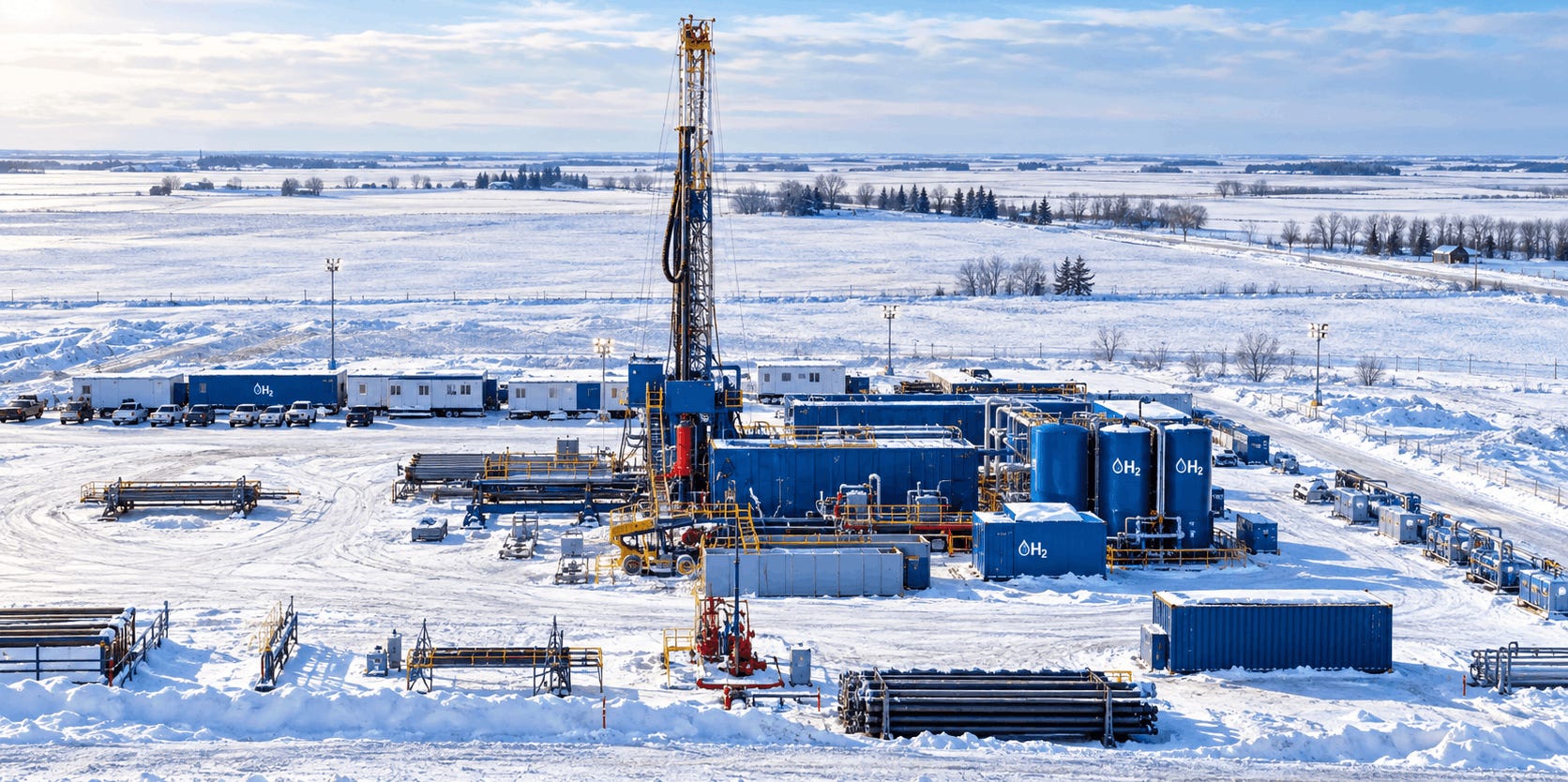
The Untapped Hydrogen Series
In 1987, a drilling crew working a water-well contract in the village of Bourakébougou, Mali, hit something they weren’t looking for. The well came up dry of water but full of gas. Nobody thought much of it — until somebpdy lit a cigarette near the wellhead and the borehole caught fire.1 The crew capped it, logged it as a nuisance, and simply moved on. There was no market for whatever had just ignited, no equipment on site built to handle it and, as far as anyone drilling water wells in West Africa in 1987 had reason to believe, no reason to think it mattered.
It would be nearly twenty years before anyone went back to find out what it was.
What they found, when they finally did, was hydrogen. Not hydrogen manufactured in a chemical plant by reforming methane and venting the carbon into the atmosphere. Not hydrogen pulled from water with a jolt of electricity from a solar farm or a nuclear reactor. Hydrogen that the Earth had made on its own, sealed under a cap of dolerite rock, and left sitting there — 97 to 98 percent pure, by later measurement, which is a purity level that most industrial hydrogen production never bothers to reach because nothing had forced it to.23
That accidental well is now widely treated, in the geological literature that has grown around this subject over the last decade, as the founding case for an entire resource category that the energy industry spent most of the 20th Century assuming couldn’t exist: natural hydrogen, produced continuously by geochemical reactions inside the Earth’s crust, accumulating in trapped reservoirs the same way oil and gas do. There this is a part which did take the field by surprise — it seemed to recharge itself over time, rather than depleting the way a conventional fossil reservoir does.45
This is the first article of a multi-part series, Untapped Hydrogen, examining the case of natural hydrogen as an emerging resource category: what it is, where the evidence says it may be found at scale, and what live commercial attempts to process it actually looks like once the geology survives contact with a drill bit. This piece is the primer. It exists to answer one question honestly, without romanticising it and without underselling it: is there a real geological case for hydrogen which doesn’t have to be manufactured — and if so, why did almost nobody take it seriously until the last few years?
More importantly, there is a real case, built on a genuine and fairly recent correction to a working assumption geologists held for decades. The deeper issue is that “real case” and “proven, investable, scaled resource” are two very different claims, and this series is going to be careful — deliberately, and sometimes tediously careful — about which one it’s making at any given time. That distinction is the whole point of writing about this subject at all right now, before marketing gets ahead of the geology.
Hydrogen Already Has a Colour Problem
Before getting too deep into what makes natural hydrogen different, it’s worth being clear about what it’s different from, because the word “hydrogen” alone doesn’t reveal much anymore. The hydrogen economy conversation of recent years has organised itself around a colour-coded taxonomy and it’s useful shorthand even though nothing about hydrogen gas is actually coloured.
Most of the hydrogen discussed in decarbonisation plans for steel, shipping, fertiliser, and heavy transport falls into one of the three main buckets — blue, green and gray hydrogen — and they share a common trait: hydrogen has to be made, on purpose, using energy and capital and industrial infrastructure, before it can be used.
Natural hydrogen — or sometimes called white hydrogen, sometimes gold hydrogen, depending on which corner of the industry is talking about it — isn’t made by anyone. It’s a byproduct of ordinary geochemical reactions which have been running inside the Earth’s crust for billions of years, entirely independent of any energy transition, climate policy, or human intention whatsoever. The question this resource category poses to the rest of the hydrogen economy isn’t “can we build a cleaner, cheaper way to make hydrogen.” It’s “what if, in specific places, we don’t have to make it at all — just go out and find where the Earth already did.”
That’s a fundamentally different kind of claim than blue or green hydrogen make, and it needs to be evaluated on its own terms rather than folded into a general hydrogen- economy narrative. It’s closer, in structure, to a historical relationship between refined petroleum products and crude oil sitting in the ground. Nobody manufactures crude oil. Either find it, or don’t.
How Much Hydrogen is Down There?
It’s worth putting some numbers next to the enthusiasm, because “natural hydrogen could be enormous” and “natural hydrogen is currently a rounding error” are both true statements at the same time, describing different things — theoretical global endowment versus proven, producible supply — and conflating them is one of the more common ways this subject gets oversold.
On the theoretical-endowment side: Geoffrey Ellis has estimated that there could be tens of billions of tons of natural hydrogen at stake — a figure which has explicitly contrasted with the nearly 100 million tons of hydrogen currently manufactured each year globally, and the roughly 500 million tons a year of hydrogen demand that have been forecasted by 2050.6 Separately, even a small fraction of that global resource, if it could be economically located and produced, could meet projected global clean-hydrogen demand for roughly 200 years.7
On the proven-supply side, the honest figure is much smaller and much more specific: one village-scale operation in Mali, running since 2012, has produced on the order of 50,000 cubic feet of hydrogen a day for 1,500 residents.8 A recent industry analysis set a bar for what would actually constitute commercial viability elsewhere — flow rates roughly at an order of magnitude above what most documented natural seeps currently deliver, sustained at 90 percent-plus purity for 20 to 30 years — and noted that wells underway in France, Idaho, and Kansas are expected to produce the first hard data against that bar sometime between 2026 and 2028.9 In other words, the field is not short on geological reasons for optimism, and it is not short on capital chasing that optimism.
What it is currently short on, almost everywhere outside Mali, is its multi-year flow and purity data from a well that has actually been produced long enough to answer the recharge-versus-depletion question this article raised earlier. That data is, per more recent trade reporting reviewed for this piece, roughly two to three years away from starting to arrive in volume — which is a quite different statement than “the resource is proven,” and this series intends to keep treating it as the difference statement that it is.
What This Series Will and Won’t Claim
Finally, it’s also worth stating the guardrails that this series is operating under plainly, up front, rather than letting them emerge implicitly across several articles.
This is not a claim that natural hydrogen is about to displace green or blue hydrogen at scale, on any specific timeline. It’s not a claim that every sedimentary basin with the right rock types will turn out to hold predictable accumulation. As such, an exploration well drilled into genuinely new plays, in any resource category, may come up dry, and there is no reason to expect natural hydrogen exploration to be systematically exempt from that pattern. A single successful, proven site — Mali — does not de-risk further exploration in Saskatchewan, Kansas, or anywhere else; each basin must be evaluated, and eventually drilled, on its own geological merits.
What this series is claiming, and is prepared to defend with the appropriate sourcing is narrower and more defensible: that natural hydrogen is a legitimate, geologically distinct resource category, grounded in real chemistry that has been experimentally and field-verified, with one commercially operating proof-of-concept facility that has run for over a decade, and a first-generation systematic effort from a credible federal science agency to identify where else the same geological ingredients may be present. That is a genuine and, until recently, underappreciated shift in how the earth sciences understand where clean energy may be found. It is also, deliberately and by design, a story still in its earliest chapters — closer to where oil and gas wildcatting once stood before the major basins had been mapped than to an actionable resource with known reserves and a settled cost curve.
Article Two in this series takes up the USGS map in full: what the petroleum- system methodology actually tells prospective capital, what it explicitly does not tell them, and where that leaves anyone trying to underwrite exposure to an exploration-stage resource with essentially no established production track record outside a single village in West Africa. Article Three turns to a current example — one operator’s exploration program in Saskatchewan, treated as a single case study with unresolved questions flagged rather than as a settled success story. It’s essentially a test of whether any of this can move from new discovery to commercial production on a schedule that matters to investors, rather than to geologists thinking in units of a billion years.
Bourakébougou took nearly two decades to go from accidental discovery to an actual, functioning power source for a small village. Whether the rest of the natural hydrogen story moves faster than that is an open question — and “faster” may not even be the right frame. This is, after all, an energy resource whose story is fundamentally one of geochemistry, a process that has been running patiently for far longer than there have been humans around to notice it. That’s the question the next two installments will try to answer honestly.
Some resources are discovered. This one was waiting.
Sources and references
Hydroma Inc., "About Us — Our History," https://hydroma.ca/about-us-our-history/
Society of Petroleum Engineers / OnePetro, "Exploration for Natural Hydrogen," https://onepetro.org/spe/general-information/2344/Exploration-for-natural-hydrogen
Prinzhofer, A. et al. (2018), "Discovery of a large accumulation of natural hydrogen in Bourakebougou (Mali)," International Journal of Hydrogen Energy, via ScienceDirect, https://www.sciencedirect.com/science/article/abs/pii/S0360319918327861
Maiga, O. et al. (2023), "Characterization of the spontaneously recharging natural hydrogen reservoirs of Bourakebougou in Mali," Scientific Reports, https://www.nature.com/articles/s41598-023-38977-y
GeoExpro, "The Natural Hydrogen Field Without Pressure Depletion," November 2022, https://geoexpro.com/the-natural-hydrogen-field-without-pressure-depletion/
CNN, "They Went Hunting for Fossil Fuels. What They Found Could Help Save the World," October 29, 2023, https://www.cnn.com/2023/10/29/climate/white-hydrogen-fossil-fuels-climate/index.html
Grist, "A Natural Hydrogen Gold Rush Is Coming to the Midwest," August 2025, https://grist.org/energy/natural-hydrogen-midcontinent-rift/
Yale Environment 360, "How 'Natural' Hydrogen Might Help Solve Our Climate Crisis," https://e360.yale.edu/features/natural-geologic-hydrogen-climate-change
Scientific American, "Once-Hidden Hydrogen Gas Deposits Could Be a Boon for Clean Energy," https://www.scientificamerican.com/article/once-hidden-hydrogen-gas-deposits-could-be-a-boon-for-clean-energy/