

ENERGY SECURITY SERIES · NO. 1
The summer before the shock
During the summer of 1973, a team of university faculty fellows convened by NASA’s Johnson Space Center, the University of Houston and Rice University set out to answer a bold question which sounded like science fiction: could hydrogen run America? They finished the early analysis in September.1 Just a few weeks later, on October 19, Arab oil producers embargoed the United States, and the price of oil nearly quadrupled, from $2.90 a barrel to $11.65 by January 1974.2
The document they produced reads today as the best warning the hydrogen industry ever received. The authors were quite blunt about the physics. Hydrogen is an energy carrier, not a primary source of energy: at the time, it could be pulled from water only by spending fossil, nuclear or solar energy, so its price followed the price of that input and the efficiency of the conversion. They priced electrolytic hydrogen at $3 to $5 per million Btu, against $1 to $1.50 for hydrogen made from coal, and warned that cheap off-peak power was too scarce. Hydrogen, they concluded, is no cure for an energy shortage. It was a way to move and store energy, once the primary supply problem is solved.
They also drew a roadmap that much of what followed set aside. Converting industrial chemical uses first, then industrial fuels, then power generation, then homes. Put cars last, because carrying enough hydrogen on board looked impractical for the foresee- able future. And they proposed how to start: a demonstration plant, which they called a Hyplex, with a guaranteed market for several years and a subsidy covering the gap between hydrogen and the conventional fuel it replaced. In today’s energy parlance, that is an offtake contract.
Cancellations, thin offtakes, and subsidy-dependent cost curves are a surefire set of project killers. The hydrogen project gains credibility by identifying the skeptic’s case before the audience does. Under this scenario, a secure and lengthy feedstock source is the strongest currency because it tilts the balance of viability.
Remember three rules from that 27-page summary. Hydrogen is a carrier, not a source. Start where the molecule is already used. Get a customer under contract before you build. The rest of this article is about what happened when the world forgot all three.
The boom: a hotel ballroom, a sunshine plan, a new department
The idea needed a name and a stage. The name arrived around 1970 when an electro- chemist named John Bockris, then at the University of Pennsylvania, used the phrase “hydrogen economy” in a discussion at a General Motors technical centre to describe cities supplied with solar-derived energy.3 That stage had arrived on March 18, 1974, when more than 700 scientists from some eighty countries gathered at the Playboy Plaza Hotel on Miami Beach for a landmark hydrogen energy conference, organised with $70,000 from the National Science Foundation.4 By the end of year they founded the International Association for Hydrogen Energy (IAHE), and then the International Journal of Hydrogen Energy, an official journal for the organisation.5
Governments soon followed. Japan formulated its Sunshine Project in 1974 as a direct response to the first oil crisis, with hydrogen identified from the start alongside solar, geothermal or coal-derived gas.6 In Washington, the 1976 Electric and Hybrid Vehicle Act authorised the first federal hydrogen program managed by the National Science Foundation, and the Department of Energy was created in 1977. DOE itself traces its hydrogen work to that period of concern over imported oil.7 President Carter called the Gulf energy crisis the “moral equivalent of war” on April 18, 1977, and signed the Department of Energy Organization Act that August.8
By 1980, hydrogen had a professional society, a Japanese national program and a line in U.S. law. What it did not have was pipes and a commercialisation strategy.
Why the momentum faded: four failures
1. The price signal reversed. In the first half of 1986, crude fell to about $12 a barrel, back to its 1974 level and, adjusted for inflation, close to the price before the first embargo.9 One account describes a four-month, 67 percent plunge after Saudi Arabia opened the taps, leaving oil just above $10. Every business case written at crisis prices evaporated at that number.
2. Policy drifted away. The incoming Reagan administration proposed cutting the Energy Department’s solar program by 60 percent or more during its first budget. The Christian Science Monitor, at that time, reported a proposed drop from $576 million to $193 million.10 Congress softened some of these budget cuts, but renewable and conservation programs were still reduced severely. (A disclosure: we did not locate a hydrogen-specific budget line in these years, so solar is the closest documented proxy for the direction of policy, not a measurement of hydrogen funding.)
3. The molecule had no free lunch. The 1973 authors said it and the Department of Energy still says it: hydrogen is an energy carrier, not an energy source.11 Its cost is tied to whatever is required to burn, split or collect to make it, plus the operational losses during conversion. When competing fuels got cheap, hydrogen had nothing to fall back on.
4. No customer, no offtake contracts. The 1973 report noted that no fuel market for hydrogen existed outside the space program, and asked for a guaranteed one.12 In the end, there is little to no evidence that a guaranteed-market demonstration of that kind was ever built, so it remains an open question. The effect is easier to see than the cause: a technology without a signed buyer is a research program, and these research programs are the first thing cut in a price collapse.
The return: the shock came back
Fifty-three years after the embargo, the pattern has now resurfaced. The International Energy Agency’s Global Hydrogen Review 2026, released on June 18, reports that the conflict in the Middle East has disrupted production and trade in hydrogen-based products. The region accounts for about one-sixth of global hydrogen production and plays a significant role in the trade of ammonia, urea, methanol and refined products. Urea prices doubled between January and May 2026.13
The 1973 authors saw the risks coming, warning that hydrogen’s cost follows its feedstock and that offtake destinations had to come first. The same pattern is visible today, with roughly 20 percent of newly signed 2025 offtake volumes backed by firm agreements. So the fair test is not whether hydrogen is a good idea, but whether a specific project can reach positive cash flow faster than the competing process it displaces, without subsidies in the base case and with a contracted feedstock source that can invert production cost on balance sheets.
The same report also mirrors the 1970s. Global hydrogen demand passed 100 million tonnes in 2025, but low-emissions production grew 20 percent to only about 1 million tonnes. The pipeline of announced projects for 2030 shrank by about a quarter to 27 million tonnes, and plant projects with a final investment decision (FID) or the strong likelihood of operating by 2030 fell from 10 million tonnes to just above 6 million. The IEA calls rising demand the key missing piece: only 20 percent of newly signed offtake volumes were backed by firm contractual commitments.14 Its security verdict is more careful, yet measured. Hydrogen can strengthen energy security over the longer term, but low-emissions hydrogen remains far from the scale needed to respond fully to the current crisis.
Policy is also on a clock. The US clean hydrogen production credit, Section 45V, offers up to $3 per kilogram for ten years, but legislation signed July 4, 2025 has moved the construction-start deadline from the start of 2033 to the end of 2027.15 The shock is back, but so is the unresolved offtake problem.
What has changed, and what has not
The molecule already has a market. Roughly 100 million tonnes of hydrogen a year is consumed today, the vast majority made from fossil fuels, in refining, ammonia and chemicals.16 In 1973 there was no established fuel market beyond space.17 A newer source no longer has to invent demand. It has to displace molecules that refiners and fertiliser makers already buy. That was the 1973 report’s own first priority, industrial chemical uses, and it is where the 2026 shock landed.18
The feedstock can arrive with a fee attached. If hydrogen follows the cost of its input, the most interesting input is one that comes with a disposal fee. The 1973 authors had listed hydrogen from wastes through bioconversion among its paths that were not yet feasible. By 1996, Congress was writing into statute an evaluation of fuel cells paired with hydrogen production from solid waste via gasification.19 A 2006 Nature analysis put U.S. landfill fees at $30-80 a tonne and incineration at about $69, with Japanese local governments paying $200 to $300.20 Those figures are nearly twenty years old, and they must be refreshed before anyone underwrites to them.
But the logic still holds up: a feedstock with a negative cost inverts the 1973 constraint.
While the technology record has been mixed, the failures are instructive. Two plasma gasification plants built in Japan, Mihama-Mikata and Utashinai, entered commercial operation in 2002 and 2003.21 Yet Nature reported in 2006 that Utashinai struggled to make ends meet, was processing about 60 percent of the waste volume expected, and used a steam turbine converting only 15 percent of the energy to electricity, because hydrogen chloride and sulphur oxides in the gas threatened a gas turbine. The article also stressed that the operating problems were not with the plasma torch itself.22 In Canada, Plasco Energy went bust in 2015 owing well over $100 million, after spending roughly four times that from its successor’s estimate. The successor’s chief executive would blame a collapse in natural gas prices for taking down the business model with it, which is the 1986 story in miniature.23
So the moat, if there is one, sits downstream of the torch. Both failures were failures of what surrounds the core reactor: turbines, gas cleanup, feedstock supply and the price of competing fuels. A 2021 account of a planned California waste-to-hydrogen project put the core conversion unit at about half the cost of a complete plant, with feedstock handling at the front and gas purification and separation at the back.24 That is where better balance-of-plant options would matter.25 This article does not claim that thesis is proven; but is the right thesis to test, and the next section shows how.
The diligence test: five things that have to be true
The 1970s provided the dress rehearsal and the failure modes which have largely been overlooked. Today, they convert directly into an underwriting checklist for every waste-to-hydrogen claim. These now include:
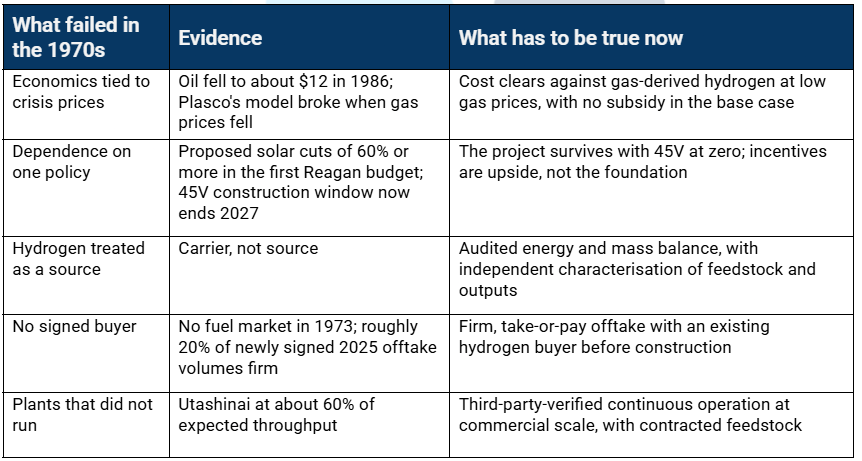
Using the benefit of hindsight, the 1973 authors have explained what to do next and in what order: start where hydrogen is already used, put a customer under contract, and never forget that the molecule is only as good as the energy and feedstock that make it. Half a century and one more oil shock later, the sectors that depend on the molecule are more exposed, and whether the technologies around it have improved enough is the core question this series sets out to test. The rule has not changed. A hydrogen project has to survive beyond the barrel, whether that’s by price or through its value in energy security.
That is the test this series will apply. The calendar starts here.
R. L. Savage et al. (eds.), “A Hydrogen Energy Carrier, Vol. I - Summary”, University of Houston, Rice University and NASA Johnson Space Center, September 1973. Source for the carrier-not-source principle, the cost comparison, the Hyplex proposal, the conversion priority order, the automobile assessment, the absence of a fuel market, and the listing of hydrogen from wastes via bioconversion as not presently feasible.
Federal Reserve History, “Oil Shock of 1973-74”: embargo instituted October 19, 1973; price rose from $2.90 to $11.65 a barrel by January 1974. Corroborated by the U.S. Department of State Office of the Historian, “Oil Embargo, 1973-1974”.
Cleveland State University Center for Economic Development, report of December 2009 (term used in 1970 at the General Motors technical center); John Bockris, Wikipedia (1970, University of Pennsylvania). A bibliometric study dates the term to 1972: Environments 10(1):11.
T. Nejat Veziroglu, “The Hydrogen Civilization Saga” (conference opened March 18, 1974; more than 700 scientists from some eighty countries; $70,000 from the NSF; association founded by end of 1974). Corroborated by the International Association for Hydrogen Energy, trust document.
The International Journal of Hydrogen Energy aims to provide a central vehicle for the exchange and dissemination of new ideas, technology developments and research results in the field of Hydrogen Energy between scientists and engineers throughout the world.
NEDO, “History of NEDO and 50th Anniversary of the Sunshine Project” (formulated 1974 in response to the first oil crisis); CIA Reading Room, document on Japan’s Sunshine Project (four resource types: solar, geothermal, coal-derived synthetic natural gas, hydrogen).
U.S. Department of Energy Hydrogen Program, “Background” (1970s import-dependence concerns; 1976 Act authorised a Hydrogen Program managed by the NSF; DOE created 1977; Hydrogen Future Act of 1996 specified evaluation of hydrogen from solid waste via gasification). Also the DOE Hydrogen Program Plan as reproduced at OpenCommons (origins in the mid-1970s energy security concerns).
Scientific American, “7 Ways Jimmy Carter Has Improved America’s Energy Future, Or Tried To” (April 18, 1977 address; DOE Organization Act signed August 4, 1977); American Presidency Project, Carter’s energy address.
Brookings, Gately, Adelman and Griffin, “Lessons from the 1986 Oil Price Collapse”, BPEA 1986 No. 2; Bloomberg, “Oil Bust of 1986 Reminds U.S. Drillers of Price War Risk”, November 26, 2014 (four-month, 67 percent plunge to just above $10).
Congressional Research Service, “Solar Energy and the Reagan Administration,” MB81265 (FY82 solar program cut about 60 percent); Christian Science Monitor, “Will solar research survive new cutbacks?”, July 2, 1981 ($576 million to $193 million proposed); Christian Science Monitor, “Reagan’s mixed success with energy policy”, January 4, 1983 (Congress restored some funding; programs cut severely since 1980).
U.S. Department of Energy, “Hydrogen: A Flexible Energy Carrier” (an energy carrier, not an energy source; must be produced from compounds that contain it).
R. L. Savage et al. (eds.), “A Hydrogen Energy Carrier, Vol. I - Summary”, University of Houston, Rice University and NASA Johnson Space Center, September 1973. Source for the carrier-not-source principle, the cost comparison, the Hyplex proposal, the conversion priority order, the automobile assessment, the absence of a fuel market, and the listing of hydrogen from wastes via bioconversion as not presently feasible.
IEA, “Middle East crisis exposes vulnerabilities in global hydrogen supply chains as low-emissions alternatives struggle to ramp up”, June 18, 2026; full report: Global Hydrogen Review 2026. Every figure in that section is from the release.
Ibid.
K&L Gates, “Navigating the One Big Beautiful Bill Act”, July 23, 2025 (signed July 4, 2025; construction must begin by December 31, 2027, versus before January 1, 2033 under the original law); McGuireWoods, client alert (10-year credit); Davis Polk, “Treasury Department and IRS issue final regulations for Section 45V” (up to $3.00 per kilogram, inflation adjusted).
Engineering News, “IEA lowers 2030 low-emissions hydrogen production outlook”, September 12, 2025 (nearly 100 million tonnes in 2024, the vast majority from fossil fuels); the IEA release in note 13 for refining, fertiliser and chemicals and the 2025 figure above 100 million tonnes.
R. L. Savage et al. (eds.), “A Hydrogen Energy Carrier, Vol. I - Summary”, University of Houston, Rice University and NASA Johnson Space Center, September 1973. Source for the carrier-not-source principle, the cost comparison, the Hyplex proposal, the conversion priority order, the automobile assessment, the absence of a fuel market, and the listing of hydrogen from wastes via bioconversion as not presently feasible.
U.S. Department of Energy, “Hydrogen: A Flexible Energy Carrier” (an energy carrier, not an energy source; must be produced from compounds that contain it).
U.S. Department of Energy Hydrogen Program, “Background” (1970s import-dependence concerns; 1976 Act authorised a Hydrogen Program managed by the NSF; DOE created 1977; Hydrogen Future Act of 1996 specified evaluation of hydrogen from solid waste via gasification). Also the DOE Hydrogen Program Plan as reproduced at OpenCommons (origins in the mid-1970s energy security concerns).
D. Cyranoski, “One man’s trash...”, Nature 444, 262-263 (2006). Source for Utashinai’s throughput, turbine efficiency, gas contaminants and the 2006 landfill and incineration fees.
Westinghouse Plasma Corporation, company history (Mihama-Mikata 2002, Utashinai 2003). A vendor source; the Nature article in note 20 dates Utashinai’s opening to 2002.
D. Cyranoski, “One man’s trash...”, Nature 444, 262-263 (2006). Source for Utashinai’s throughput, turbine efficiency, gas contaminants and the 2006 landfill and incineration fees.
D. Reevely, “After a $400M flameout, an Ottawa waste-to-energy company draws influential backing”, The Logic, December 10, 2021.
Ibid.
NexusInnovest’s thesis is that plasma gasification, combined with improved balance of plant integration, resets the entire competitive position across the mobility and industrial sectors that already buy hydrogen in the millions of tonnes (and that doesn’t include stranded and underserved vehicle fleets).