

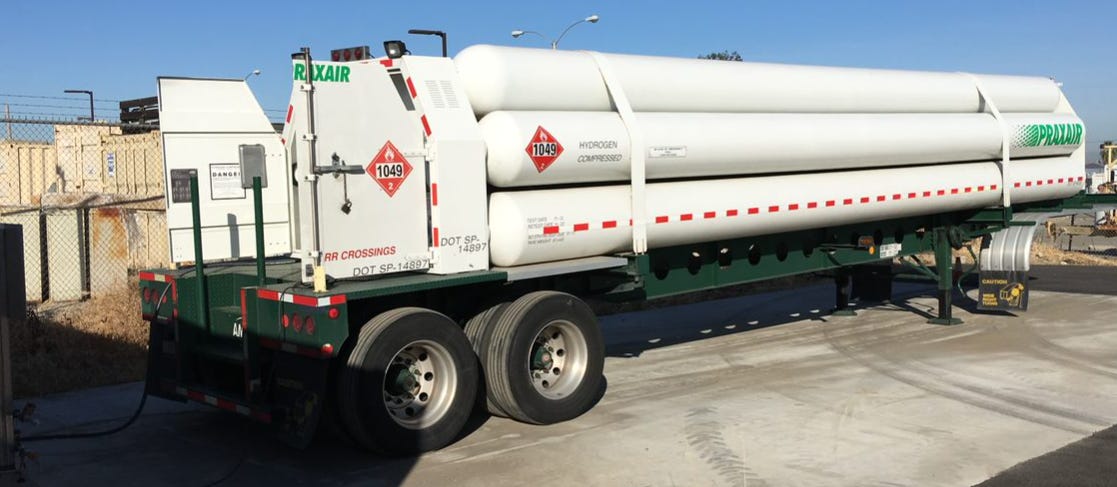
An Editorial
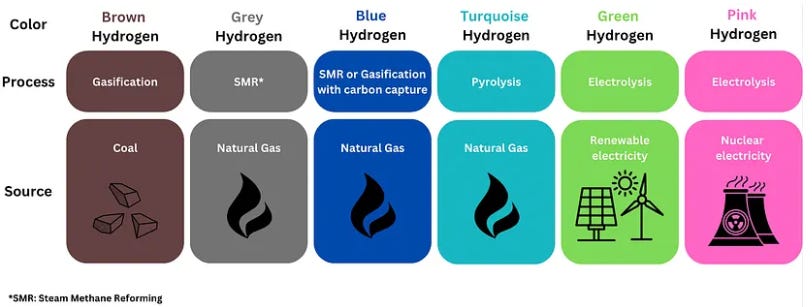
For more than a decade, hydrogen has been sold to the market from a paint chart — as if it was a tacked up diagram in the home improvement section at a Home Depot. Green for renewable electrolysis. Blue for fossil gas with carbon capture. Grey for the uncaptured version nobody wants to mention anymore. Pink for nuclear, turquoise for pyrolysis, white for what nature already buried underground. It was a tidy system, easy to put in a press release, easy for a policymaker to reference in a subsidy bill, easy for a buyer to search for on term sheets.
It was also, as it turns out, mostly wrong. A primative way of defining and classifying the most abundant element in the universe.
Not wrong in the sense of being fabricated — as each colour genuinely described the range of hydrogen production methods. Wrong in the sense that these colours were never actually measuring the thing investors, regulators, and buyers cared about: how much carbon a given kilogramme of hydrogen was responsible for, cradle to gate. A “green” hydrogen project running on grid electricity in a coal-heavy region can carry a larger carbon footprint than the grey hydrogen it was meant to replace — sometimes several times larger, once accounting for the emissions intensity of the power actually feeding the electrolyser. A “blue” project can claim high capture rates on paper while upstream methane leakage, often undercounted by regulators, quietly erases much of the climate benefit. The label survives the audit. The molecule doesn’t.
This is hydrogen’s colour problem, and it has stopped being an academic footnote. It is now a capital allocation problem.
"The concept of a color wheel is reaching a saturation point where it no longer can assign any more primary colors to new pathways..."
- Redefining Clean Hydrogen: From Colors to Emissions, Berkeley Lab Energy
When a Label Stops Doing Its Job
The proof lies in where the money has gone. Since 2018, roughly nine billion dollars in green hydrogen (GH2) projects have been cancelled, and the broader clean hydrogen investment pipeline has continued to contract even as headline announcements keep coming. Recent capital has, if anything, tilted back toward blue hydrogen — not only because blue is climate-superior, but because its cost structure is more forgiving and its risks are better understood. Meanwhile, in the United States, it took the Treasury Department more than two years to finalise the rules that determine what actually qualifies for the 45V clean hydrogen tax credit — years in which developers couldn’t underwrite projects with any confidence, because the definition of “clean” was itself under negotiation. A subsidy regime built on colour, rather than measured carbon intensity (CI), turned out to be a subsidy regime built on sand.
The uncomfortable truth is that colour was never really a technical classification. It was a communications tool — a way to make an emerging hydrogen economy seem less opaque and feel closer to inevitable than it actually was. That’s not a cynical read; it’s a sum of the parts of a narrative and what can happen when an industry needs a simple story before it has concrete data. But buyers with critical offtake obligations and real decarbonisation targets don’t transact on stories. They need a number: grams of CO₂-equivalent per kilogramme of hydrogen, measured across the full value chain — and that includes feedstock, conversion, transport, end use data. Increasingly, that carbon-intensity (CI) figure is what shows up in contracts, not a colour swatch.
Which raises an interesting concern for anything in the market that doesn’t fit neatly into a swatch diagram to begin with.
Enter RTH
Renewable thermolytic hydrogen — RTH — is the clearest example of a pathway the colour system simply has no box for, because it wasn’t designed with a category like this in mind at all.
RTH describes hydrogen produced by thermally decomposing all of the biomass and wastewater residuals — municipal solid waste, agricultural residue, sewage sludge — at extreme temperatures. Typically with plasma torches, these systems can operate in the 1,200-to-4,000°C range, and doing it on-site, powered substantially by internal syngas and heat, rather than by grid electricity. It defies the electrolysis pathway for its claim of producing green hydrogen, nor is it a fossil-fuel reforming pathway. It doesn’t split water with imported electrons, and it doesn’t crack methane that is pulled from a pipeline. It converts the waste liability sitting in a landfill, at a dairy or meat processing facility or a treatment lagoon into a hydrogen-rich syngas stream, while already using the energy harvested from the waste itself.
Try to assign RTH a colour and the system breaks almost immediately. It isn’t green, as there’s no electrolysis and often no grid connection to certify as renewable in the first place. It isn’t grey or blue, because there’s no methane feedstock. It isn’t turquoise, as the carbon being managed is biogenic, and not from a fossil fuel source. The closest existing category — biomass gasification — undersells what’s distinctive about it, as most biomass-to-hydrogen literature assumes grid-tied, centralised plants. RTH, done properly, is neither centralised nor grid-tied.
That mismatch isn’t a labeling inconvenience. It’s evidence that the colour taxonomy was built around a two-variable, linear working space — fossil fuels versus renewable electricity — that no longer describes the actual frontier of hydrogen production.
Why RTH Can Go Where Green Hydrogen Can’t
Here is the part that should get an investor’s attention: RTH isn’t just carbon-neutral by virtue of using biogenic feedstock. Under the right configuration, it can go carbon-negative, and it can do so through more than one mechanism stacked on top of each other.
The first mechanism is avoidance. Landfilled organic waste decomposes anaerobically and releases methane, a gas roughly twenty-five times more potent than CO₂ over its atmospheric lifetime. Diverting that same waste into a thermal conversion process — one that releases biogenic CO₂ rather than methane — is itself a negative-emissions move relative to the landfill counterfactual, before any carbon capture equipment is even installed.1 Life-cycle assessments comparing plasma-gasified municipal waste hydrogen against both landfill disposal and conventional incineration have found net-negative outcomes on exactly this basis.
The second mechanism is capture. Because the extreme heat of plasma gasification produces an unusually clean, concentrated syngas stream, in-situ CO₂ sorption — using materials like calcium oxide or lithium silicate to pull carbon out of the gas as it’s produced — is more tractable here than in many other gasification routes. Stack that capture step on top of the avoided-methane credit, and the result is a hydrogen molecule which is measurably, not just rhetorically, carbon-negative.
The third piece is the one buyers rarely price in because it often doesn’t show up in a carbon-intensity (CI) number at all: destruction value. Extreme process heat doesn’t just convert carbon — it destroys pathogens, breaks down persistent contaminants, and eliminates the need for the energy- and chemical-intensive infrastructure of conventional wastewater treatment. A facility processing sewage sludge this way isn’t only making hydrogen; it’s replacing a treatment plant. That’s an environmental and economic benefit sitting entirely outside of the colour framework, and outside most carbon-accounting frameworks too.
"Biomass, if managed sustainably can provide the 'sink' for carbon that, if utilized in concert with low-carbon generation technologies, can enable us to reduce carbon in the atmosphere."
- UC Berkeley Vice Chancellor for Research, on Sanchez/Kammen et al., Nature Climate Change
None of this makes RTH a free lunch. Plasma torches are genuinely power-hungry, so running a facility autonomously — burning a fraction of its own syngas to sustain the torch rather than drawing from the grid — comes at a real efficiency cost. Engineering studies on this trade-off have found some drops in exergetic efficiency2 as reliance on the waste-derived energy loop increases. Commercial-scale deployment has struggled historically with this tension between waste-destruction capability and the net energy output, and only a handful of pilot and demonstration facilities — from India, Sweden, and a few other markets — are proving out the concept at meaningful scale.3 RTH is indeed real, but it is not yet mature in production, and investors evaluating it should treat the energy-balance question as an underwriting risk, not as a footnote.
What This Means for How the Conversation Should Be Reframed
The lesson here isn’t “add a new colour for RTH.” It’s that the entire colour-based framework was always a proxy for a question it never actually asked directly: what happens to atmospheric carbon, net, across the full system, including the counter-factual of doing nothing?
For investors and project planners, that suggests three shifts in how due diligence should actually work. First, evaluate lifecycle carbon intensity directly, not the label attached to a production method. A project’s disclosed number, ideally third-party verified, should carry more underwriting weight than its marketing category. Second, price in counterfactual and co-benefit values explicitly: avoided landfill methane, the avoided water-treatment infrastructure, and contaminant destruction have economic and environmental value that a pure CI figure won’t capture, as pathways like RTH are disproportionately rewarded for this once it’s modeled properly. Third, treat an energy self-sufficiency claim with a same level of scrutiny that are reserved for carbon claims — “autonomous” and “off-grid” are increasingly used as selling points, and yet they deserve the same lifecycle rigour as “green” once did, precisely because the industry has already learned, the hard way, what happens when a compelling label can project something different than the underlying data.
Decentralisation is reshaping the energy landscape, making markets more dynamic, flexible, and capable of accommodating much-needed energy growth.
- Hogan Lovells, legal/policy analysis on market structure shifts
Hydrogen’s colour problem was never really about colour. It was about a linear energy industry that reached for a simple taxonomy before it had the measurement discipline to back it up. RTH doesn’t solve that problem by squeezing it into a new box. It simply limits the damage by making the colour boxes themselves look increasingly misplaced by defying the underlying logic that has been used to describe an obscure industry.
The hydrogen transition waits for no one.
"Life cycle assessment of hydrogen production from municipal solid waste gasification" — indexed via CORE (core.ac.uk)🔗 https://core.ac.uk/works/136510603
Exergetic efficiency, also known as second-law efficiency or rational efficiency, measures how effectively a system converts available energy (exergy) into useful work, representing the ratio of exergy output to exergy input. Unlike first-law energy efficiency, which only accounts for quantity, exergetic efficiency accounts for the quality of energy and highlights internal irreversibilities and losses.
"Plasma Gasification as a Waste to Energy Technology: A Review of Recent Advances and Future Outlook" — MDPI, Energies journal
🔗 https://www.mdpi.com/1996-1073/15/4/1475