

The Untapped Hydrogen Series
Article Two built a framework for underwriting natural hydrogen: presence, retention, deliverability, persistence, and commercial chain. It used Kansas as a live test, and the answer there was a caution — a rock that shows hydrogen in drilling mud is not a well that flows it. This article runs the same framework against a more advanced case: MAX Power Mining Corp.’s Lawson discovery in south-central Saskatchewan, the program furthest along toward the “next phase” that Article Two flagged, with testing expected to be completed between 2026 and 2028.
One point needs to be precise before the risk-by-risk work starts. Lawson sits in south-central Saskatchewan, Canada — just north of the U.S. border, and entirely outside the USGS prospectivity map examined in Article Two, which scores only the conterminous United States. Nothing here should be read as the map extending north to cover it. Or the geological logic behind it — source, reservoir, seal — as none of it travels across the border; the map itself does not, and neither does its calibration against any well head in the U.S.
The discovery, in sequence
MAX Power Mining Corp. (CSE: MAXX; OTC: MAXXF; FSE: 89N) is a Saskatoon-based exploration company, incorporated in 2021, that has repositioned itself as what one market commentary called a “pure-play” natural hydrogen story after transferring its earlier lithium interests to Homeland Critical Minerals.1 Its case rests on the Lawson Natural Hydrogen Complex near Central Butte, on a 1.3-million-acre area across the 475-kilometer Genesis Trend.2
The company haso confirmed what it calls Canada’s first subsurface natural hydrogen discovery at the Lawson 1 well: hydrogen concentrations up to 28.6% (286,000 ppm), helium up to 8% as a co-product, gas that flowed freely to surface, and basement source rocks identified at roughly two kilometers depth.3 In June 2026, a step-out 325 kilometers southwest at Bracken, inside the 750-square-kilometer Grasslands Project near the Montana border, returned helium readings up to 8.7% from a well drilled to 2,600 meters, with an independent petrophysical evaluations by GLJ Ltd. identifying multiple prospective hydrogen and helium zones, and calling it evidence of a basin-scale system rather than an isolated anomaly.45
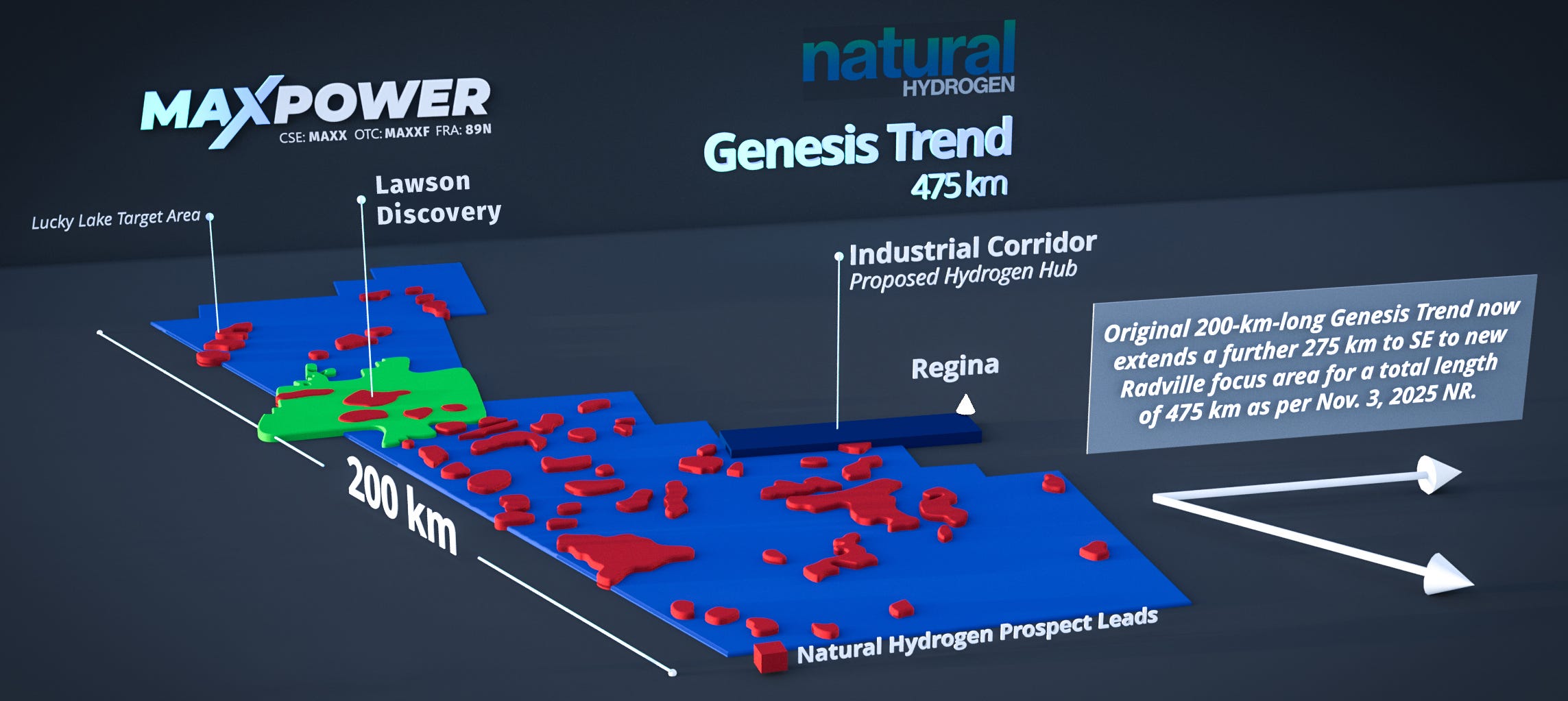
MAX Power’s 475-km exploration corridor spans two play concepts approximately325 km apart. Credit: MAX Power Mining Corp. investor materials.
A multi-well “commercial validation” campaign began at Lawson in July 2026, using Savanna Drilling Rig #416 following a 3D seismic survey and independent reservoir modeling.6 Lawson 2 was cased and used to help triangulate the deposit; Lawson 3 was spudded in early August 1.2 kilometers south of the discovery well.7 By early September, the company reported Lawson 3 had triangulated “a very large” system, while Lawson 4 — drilling in parallel — had intersected what it interpreted as a major crustal fault with strong hydrothermal activity and the highest hydrogen readings recorded to date; the company’s permitted land position grew to 2.5 million acres in the same update.8 Core recovered near the Lawson 1 offset showed mafic minerals, potassium feldspars, hematite and alteration minerals tentatively identified as epidote and serpentinite — or mineralogy consistent with a serpentinisation source story.9
Lawson 5, a 27-to-31-kilometer step-out announced September 15, intersected a 20.5-meter interval with strong permeability and porosity in the basal Cambrian sandstone, immediately above the Precambrian basement.10 The company’s chief geoscientist described the completions program that follows Lawson 5 as the stage where gas composition, deliverability and “ultimately the potential commerciality” of the system get evaluated — explicitly framed as the next phase, not the current one. As of the most recent public update, September 21, that completions and flow-testing phase had not yet started; the company had instead engaged Kyndryl Canada to build a commercialisation strategy for its AI-assisted exploration-targeting platform, MAXX LEMI.11
The five risks, applied
Presence risk — well supported, multiply corroborated. Five hydrogen wells across two play concepts 325 kilometers apart, an independent GLJ petrophysical review, and lab-validated readings put Lawson well ahead of the single-well, accidental-discovery pattern that Article Two flagged as the historical norm for natural hydrogen. This is the strongest of the five risks, but it inherits the same caveat as Kansas: mud-gas and wire-line readings describe what is in the rock, not what will flow from a well.
Retention risk — largely left unaddressed in public disclosure. The September 15 interval is described in terms of reservoir quality — permeability and porosity — not seal integrity. None of the public releases have characterised the caprock or trapping mechanism the way that the discovery well’s source rock and the Bracken step-out’s analog geology have been characterised. The GLJ work at Bracken identified several “prospective” zones, which is a screening judgment, not a confirmed trap.12
Deliverability risk — explicitly deferred by the operator. Every well since Lawson 1 has been described by the company in the vocabulary of triangulation, expansion and de-risking, not flow. The chief geoscientist’s own framing places gas composition and deliverability testing after Lawson 5, in a completions program which, as of the latest update, had not begun. This is the risk the market is most exposed to and one with the least public evidence attached to it.
Persistence risk — no public data. Nothing in the release history addresses whether the Lawson system recharges over time or represents a fixed, depleting accumulation, the same gap Article Two identified at Mali’s Bourakébougou site.
Commercial-chain risk — structurally different from the U.S. case, and partially resolved. Article Two noted that U.S. natural-hydrogen exploration sits on landowner-held mineral rights. Saskatchewan’s tenure system is the reverse across most of the province: roughly four-fifths of Saskatchewan’s mineral rights are Crown-owned, with the remaining fifth held as a freehold.13 Most notably, the province ran its first-ever competitive public offering specifically for helium and “associated gases” Crown rights in June 2026, citing growing industry interest in helium and natural hydrogen as the reason. That is a live regulatory response, not a settled framework — Saskatchewan currently produces about 3% of world helium supply and is folding natural hydrogen into an existing helium leasing structure rather than building a bespoke one.14 Helium permits under that same structure grant exploration rights only; production requires a separate lease.15 Purification, compression and offtake infrastructure for Lawson gas are not described in any release reviewed for this article.
What the market is pricing in
MAX Power’s shares rose more than 800% over the twelve months to May 2026, with investor Eric Sprott’s stake reported at 12.8% around the same period. By mid-August, coverage described the stock “retreating” on valuation concerns, noting explicitly that considerable uncertainty remains “until the commercial flow rates and economics are demonstrated.”16 The company raised roughly C$20.5 million in a brokered offering in March 2026 to fund the program.17
The pattern is worth naming plainly: the equity has already re-rated substantially on presence evidence, while the risk category the operator itself says is still pending — deliverability — remains open. That gap between what has been shown and what has been priced is the same gap Article Two flagged at McCoy-1, just earlier in its life cycle and with a materially stronger geological case behind it.
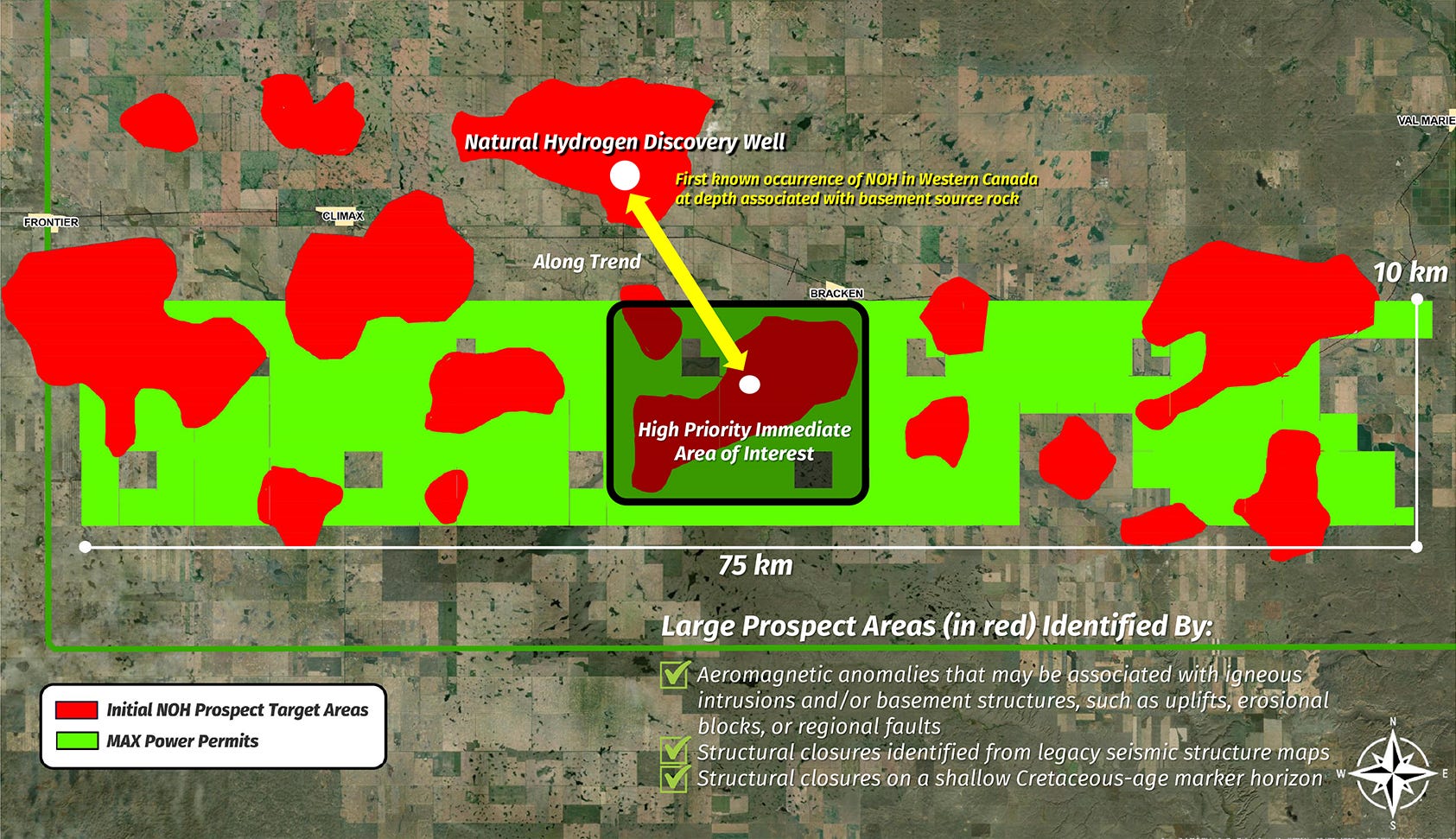
Presence evidence has accumulated steadily across five wells; deliverability evidence has not yet been generated. Credit: compiled from MAX Power public disclosures.
Where GH2E fits, and where it doesn’t
Article Two identified three interfaces between GH2E’s waste-to-hydrogen-and-water platform and natural-hydrogen exploration: water for stimulation, shared surface infrastructure, and a siting overlay. None applies cleanly to Lawson. There is no public indication of a stimulation component at Lawson — the play is framed throughout as accumulated, naturally generated hydrogen, not an injection-stimulated system. Any form of surface-infrastructure sharing is speculative until a production well and a full purification train actually exists, which is precisely the phase the operator says has not started. A siting overlay is possible in principle — MAX Power’s land package could in theory be checked against waste and water-demand layers the way the USGS source-COS rasters were suggested for U.S. acreage — but Saskatchewan’s rural farmland is a much different demand context than the industrial corridors that GH2E’s targets, and no such overlay exists today. The honest read is that Lawson is a useful underwriting exercise on its own and not, at this stage, a GH2E adjacency.
What comes next
Article Two flagged stimulated hydrogen — from injecting water into iron-rich rock to generate hydrogen on demand, rather than searching for an accumulation — as the interface with the most direct relevance to GH2E’s own technology — and also one with the least commercial proof behind it. Article Four takes that concept on its own terms: what the Oman pilot data actually showed, what “orange hydrogen” claims about using seawater or wastewater as its injectate, and what would have to be true about electrocoagulation by-product chemistry for a treatment-as-a-service platform to plug into that process at all. The unresolved items get marked as such, the same as here.
Lawson asks whether nature already made the hydrogen. Article Four asks whether GH2E's own chemistry could make it instead — and whether that's the door worth walking through, or a door worth being honest about not opening just yet.
Sources and References
Kalkine, “MAX Power Mining Stock Retreats as Valuation Concerns and Natural Hydrogen Execution Risk Pressure CN:MAXX” (Aug 19, 2026): https://kalkine.ca/news/energy/max-power-mining-stock-retreats-as-valuation-concerns-and-natural-hydrogen-execution-risk-pressure-cnmaxx
The Globe and Mail / TipRanks, “Max Power Confirms Landmark Natural Hydrogen Discovery in Saskatchewan” (Jan 17, 2026): https://www.theglobeandmail.com/investing/markets/markets-news/Tipranks/37098208/max-power-confirms-landmark-natural-hydrogen-discovery-in-saskatchewan/
Discovery Alert, “Max Power Mining’s Saskatchewan Natural Hydrogen Discovery Explained” (Jun 14, 2026): https://discoveryalert.com/natural-hydrogen-saskatchewan-max-power-mining-discovery-2026/
Hydrogen Central, “Max Power Confirms Basin-Scale Natural Hydrogen Potential in Saskatchewan with Bracken Well, 325 Km from Lawson Discovery” (Jun 30, 2026): https://hydrogen-central.com/max-power-confirms-basin-scale-natural-hydrogen-potential-in-saskatchewan-with-bracken-well-325-km-from-lawson-discovery/
Stocks Today, "Max Power Mining Stock Cools Off After Record Run as Market Awaits Commercial Proof from Saskatchewan Hydrogen Project" (May 21, 2026): https://stockstoday.com/max-power-mining-stock-cools-off-after-record-run-as-market-awaits-commercial-proof-from-saskatchewan-hydrogen-project/
Interesting Engineering, “Canada advances world’s first natural hydrogen discovery toward commercial production” (Jul 14, 2026): https://interestingengineering.com/energy/lawson-canada-natural-hydrogen-commercial-production-phase
Yahoo Finance / GlobeNewswire, “MAX Power Commences Second Commercial Validation Well at Lawson to Triangulate Canada’s First Natural Hydrogen Deposit” (Aug 6, 2026): https://finance.yahoo.com/energy/articles/max-power-commences-second-commercial-122300998.html
Nasdaq / GlobeNewswire, “MAX Power Drills into Highest Natural Hydrogen Readings to Date in Third and Fourth Wells at Lawson as Discovery Expands” (Sep 8, 2026): https://www.nasdaq.com/press-release/max-power-drills-highest-natural-hydrogen-readings-date-third-and-fourth-wells-lawson
Simply Wall St, Max Power Mining (CNSX:MAXX) stock analysis, core description (Aug 18, 2026): https://simplywall.st/stocks/ca/materials/cse-maxx/max-power-mining-shares
Metal Tech News, “MAX Power extends Lawson hydrogen system” (Sep 8, 2026): https://www.metaltechnews.com/story/2026/09/09/tech-bytes/max-power-extends-lawson-hydrogen-system/2945.html
GlobeNewswire, “MAX Power’s Lawson 5 Well Targets Scale Potential of Current Natural Hydrogen Discovery Area and Broader Genesis Trend Extending >475 km to North Dakota” (Sep 21, 2026): https://www.globenewswire.com/news-release/2026/09/21/3365432/0/en/max-power-s-lawson-5-well-targets-scale-potential-of-current-natural-hydrogen-discovery-area-and-broader-genesis-trend-extending-475-km-to-north-dakota.html
Hydrogen Central, “Max Power Confirms Basin-Scale Natural Hydrogen Potential in Saskatchewan with Bracken Well, 325 Km from Lawson Discovery” (Jun 30, 2026): https://hydrogen-central.com/max-power-confirms-basin-scale-natural-hydrogen-potential-in-saskatchewan-with-bracken-well-325-km-from-lawson-discovery/
SARM, “Petroleum Tenure and Development South of the Divide” (mineral ownership data): https://sarm.ca/wp-content/uploads/2022/03/petroleum-tenure-and-development-south-of-the-divide.pdf
Saskatchewan Ministry of Energy and Resources, “Questions and Answers: Helium and Associated Gases Crown Public Offering” (Jun 2026): https://www.saskatchewan.ca/-/media/news-release-backgrounders/2026/jun/qsas-helium-and-associated-gases-public-offering.pdf
Saskatchewan.ca, Crown Land Sales, Dispositions and Tenure — Helium and Associated Gases Permits and Leases: https://www.saskatchewan.ca/business/agriculture-natural-resources-and-industry/oil-and-gas/crown-land-sales-dispositions-and-tenure/crown-dispositions/non-advertised-dispositions
Kalkine, “MAX Power Mining Stock Retreats as Valuation Concerns and Natural Hydrogen Execution Risk Pressure CN:MAXX” (Aug 19, 2026): https://kalkine.ca/news/energy/max-power-mining-stock-retreats-as-valuation-concerns-and-natural-hydrogen-execution-risk-pressure-cnmaxx
Junior Mining Network, Max Power Mining news and financing history: https://www.juniorminingnetwork.com/market-data/stock-quote/max-power-mining.html