

On March 16, a photographer at Yantai Port in Shandong captured a cargo ship taking on fertiliser.1 Only two days earlier, according to one trade-policy analysis, Beijing had begun restricting exports across nearly every fertiliser category: nitrogen, phosphate, potash and blends.2 Nothing was formally announced. Reuters’ sources described a ban that had arrived quietly, and the agency estimated that between half and three-quarters of China’s 2025 fertiliser exports were now restricted.
The timing could hardly have been worse. The Strait of Hormuz, which carries nearly a quarter of global urea exports, was disrupted; Iran halted ammonia production, and Qatar had suspended urea, ammonia and sulfur after damage to key facilities.3 About 30% of traded fertiliser normally passes through that waterway.4
Then the exporters began their closing doors one by one. Russia restricted ammonium nitrate on March 24, and later fertiliser mixtures from June through November. Egypt, the fourth-largest nitrogen exporter, imposed an export tax between May and August. India, which took more than 40% of its urea and diammonium phosphate (DAP) from the Middle East last year, asked Beijing for urea quotas.
The World Bank expected urea prices to rise nearly 60% in 2026, then ease in 2027 as Middle East exports recover and gas prices moderate.5 Note the condition buried in that forecast: relief depends on the same chokepoints reopening.
Fertiliser, it turns out, is less a commodity than a permission slip.
The Green Answer That Stalled
The clean answer was supposed to be green ammonia: electrolysers, renewable power and a plant beside the local port. In Sauda, Norway, a 240 MW project built for exactly that, Iverson eFuels, a vehicle of Hy2Gen and Copenhagen Infrastructure Partners, was cancelled in early March.6 7 The grid operator Statnett had withdrawn the 270 MW it allocated because the project ran more than two years behind schedule. New capacity, Statnett said, would not arrive before a network upgrade planned for 2033 to 2035. The developer said it wanted to explore a data centre on the site instead.
The technology did not fail in Sauda. The schedule slipped, and the grid slot dissolved with it.
The picture is not all retreat. Fertilizer Daily reports that green ammonia moved into large-scale construction in 2026 as electrolyser costs fell. The same report says many projects planned for 2025 and 2026 slipped by just one or two years, and that green ammonia remains a small share of supply by 2030.8 However, a shortage that bites in 2026 cannot be solved by plants that arrive later in the decade.
A Different Starting Point
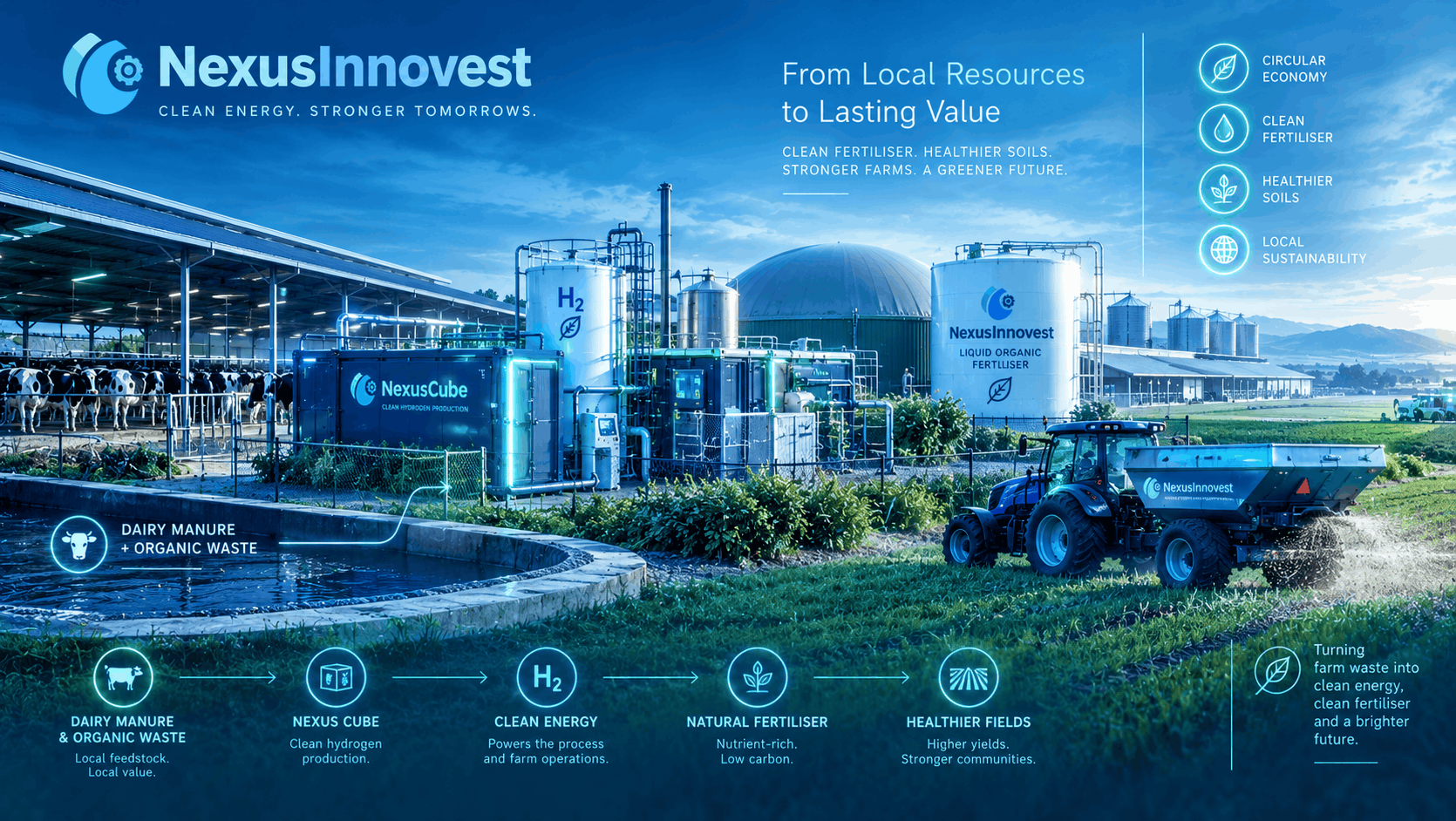
The GH2E design starts at the other end of the chain. It takes a waste stream, powers itself, and separates hydrogen in real time. The design case is one metric ton an hour of paunch manure plus 1,600 litres an hour of repurposed water, with a target of 125 kg of hydrogen per hour.9 No interconnection queues, no electrolysers, no import terminal. Those are company design figures, not independently verified yield, and the last section returns to them.
Then the loop closes where the chemistry insists it must. Ammonia is nitrogen from air combined with hydrogen: N₂ + 3H₂ → 2NH₃. The waste does not supply the nitrogen; an air separation unit does. What the gasifier supplies is the most expensive part, the hydrogen, and, in principle, the CO₂ that urea synthesis consumes.
At 125 kg of hydrogen an hour, stoichiometry provides about 5.6 kg of ammonia per kilogram of hydrogen. That is roughly 700 kg an hour, 17 tonnes a day, or about 5,600 tonnes over 8,000 operating hours.10 It is a cooperative’s supply, and not a global market. A Guyana ammonia-urea project, which analysts describe as small relative to world production, targets 300,000 tonnes a year. Matching it would take roughly fifty such modules.
What a Kilogram of Hydrogen Is Worth
U.S. Gulf ammonia reached $705 a short ton on March 27, up 78% on a year earlier.11 Converting this to metric tonnes and applying the 5.6 kg of ammonia per kilogram of hydrogen gives the gross value of the hydrogen if it leaves the plant as nitrogen.12

Hydrogen sold embodied as ammonia can be converted at the stoichiometric ratio of ~5.6 t NH₃ per t H₂. Multiplying by an ammonia price established the gross ammonia-equivalent revenue, before nitrogen sourcing, synthesis, and handling costs. It should not be read as the standalone value of the hydrogen in a business case.
Both figures are gross: before nitrogen supply, synthesis capital, storage and handling. They are a ceiling on what hydrogen can earn through this route, not a margin.13 The point is direction. In a tighter market, a hydrogen molecule sold as nitrogen could be worth more than one sold at a fence line, and the spread between that ceiling and the cost of making ammonia on site is what pays for the loop.
What Would Break It
Four things, in the order a diligence team would find them:
Track B. Hydrogen yield at scale depends on characterising the organic content of the treatment sludge, which remains unresolved.14 Until it is, 125 kg an hour is the target, and every number above scales with it.
Price reversion. The World Bank expects urea to ease in 2027 if Gulf exports recover.15 The case has to clear at last year’s $395, not this spring’s $705.
Small-scale synthesis. Seventeen tonnes a day is far below conventional plant scale. Clustering modules around a shared synthesis hub is the obvious answer, and it is untested here.
Carbon premiums. EU importers now buy Carbon Border Adjustment Mechanism (CBAM) certificates, priced at €82.32 during the third quarter of 2026.16 But one analysis puts the 2026 price effect on urea at €1.4 a tonne, and green ammonia remains significantly more expensive than the conventional product.17 Do not underwrite a premium the market has not yet paid.
In March, fertiliser needed permission: from a strait, a ministry, or a grid operator. The case for autonomous gasification is that manure needs none of the three. Whether it can make nitrogen at a price that farmers will pay is the question diligence has yet to answer.
References and sources
Reuters, republished by The Western Producer, China restricts fertilizer exports, further crimping war-tightened supply, March 19, 2026. Supports the unannounced mid-March ban, the half-to-three-quarters estimate, the Yantai photo caption (March 16), India’s import dependence and the expectation that bans would not lift before August. Scope differs by source: Reuters’ sources named nitrogen-potassium blends and certain phosphates on top of existing urea limits, while note 2 describes nearly all categories.
IICA, The Hidden Cost of Fertilizer Export Restrictions in Times of Crisis. Supports China’s March 14 start date, Russia’s March 24 ammonium nitrate and June to November mixture restrictions, Egypt’s May to August export tax and 6% share, and the Guyana 300,000 t/yr project.
World Bank Data Blog, Fertilizer prices surge as Strait of Hormuz disruptions tighten supply. Supports the nearly-one-quarter urea share, the Iran and Qatar outages and the 2026 and 2027 urea outlook.
Fertilizer Daily, Green ammonia moves into the execution phase, June 24, 2026 (citing PV Magazine India). Supports the roughly 30% Hormuz share, the construction phase, the one-to-two-year delays and the small 2030 share.
Ship & Bunker, Norway’s Green Ammonia Project with Marine Fuel Ambitions Scrapped, March 11, 2026. Supports Statnett’s 270 MW withdrawal and the two-year delay.
Ibid.
Hydronews, Hy2Gen cancels its 240 MW green ammonia electrolysis project in Sauda, March 10, 2026. Supports the 240 MW size, the 2033 to 2035 grid upgrade and the exploratory data-centre plan.
Fertilizer Daily, Green ammonia moves into the execution phase, June 24, 2026 (citing PV Magazine India). Supports the roughly 30% Hormuz share, the construction phase, the one-to-two-year delays and the small 2030 share.
NexusInnovest GH2E design case (1 t/hr paunch manure, 1,600 L/hr water, 125 kg/hr hydrogen target). Company figures, not independently verified; yield at scale is contingent on resolving the sludge TOC/DOC characterisation (Track B).
Author’s calculation. N₂ + 3H₂ → 2NH₃ with molar masses 2.016 and 17.031 g/mol gives 5.63 kg NH₃ per kg H₂; 125 kg/hr gives about 704 kg/hr, 16.9 t/day and, at 8,000 hours, about 5,630 t/yr. The 300,000 t comparison divides by that figure (about 53).
Advanced Turf Solutions, US Fertilizer Market Update, March 30, 2026. NOLA ammonia $705 to $706 against $395 to $396 a year earlier (+78%); the lower bound is used here.
Author’s calculation. Dollars per short ton divided by 0.90718 gives dollars per metric ton; multiplied by 5.63 kg NH₃ per kg H₂ and divided by 1,000 gives dollars per kg of hydrogen consumed. Gross value only.
Ratio from ammonia stoichiometry (N₂ + 3H₂ → 2NH₃); hydrogen is ~17.6–17.8% of ammonia by mass (U.S. DOE, “Potential Roles of Ammonia in a Hydrogen Economy”). the reference does include the missing costs. Getting from H₂ to NH₃ requires an air separation unit for N₂, a Haber-Bosch loop (high pressure and temperature), compression, synthesis catalyst, energy, and storage. None of that is in a simple 5.6× multiplier. Calling the result “gross value” is fine only if the reader is told that it’s before conversion costs.
NexusInnovest GH2E design case (1 t/hr paunch manure, 1,600 L/hr water, 125 kg/hr hydrogen target). Company figures, not independently verified; yield at scale is contingent on resolving the sludge TOC/DOC characterisation (Track B).
World Bank Data Blog, Fertilizer prices surge as Strait of Hormuz disruptions tighten supply. Supports the nearly-one-quarter urea share, the Iran and Qatar outages and the 2026 and 2027 urea outlook.
Irish Farmers Journal, The nuts and bolts of CBAM. Supports the Q3 2026 certificate price of €82.32 and the statement that green ammonia remains significantly more expensive.
Sandbag, CBAM and fertiliser inflation in 2026, February 10, 2026. About €1.4 a tonne of urea at an €80 carbon price and 80% pass-through. The same analysis puts importer compliance cost near €7.4 a tonne for efficient plants, a cost rather than a price effect.