

Infrastructure Series
Hydrogen has a color problem. Green hydrogen carries electrolysis costs that keep it stranded well above fossil parity. Blue hydrogen leans on carbon capture rates that, in practice, rarely hit their design specs. Both are trying to solve decarbonisation from the demand side — clean up the process, hope that the credits follow.
Renewable Thermolytic Hydrogen (RTH) attacks this problem from the other direction. Instead of purifying an input, it monetises an output nobody wanted in the first place: waste that is already decomposing, already off-gassing, already generating a liability on someone’s balance sheet. Run that waste through thermal conversion — plasma gasification, in the GH2E platform’s case — and the hydrogen that comes out doesn’t just avoid emissions. Under the right accounting framework, this registers as carbon-negative, because the baseline it’s measured against isn’t zero. It’s the methane that would have escaped anyway.
That distinction is the entire investment thesis. It’s also the part that deserves the most scrutiny before it goes in front of an underwriter.
Where the negative sign actually comes from
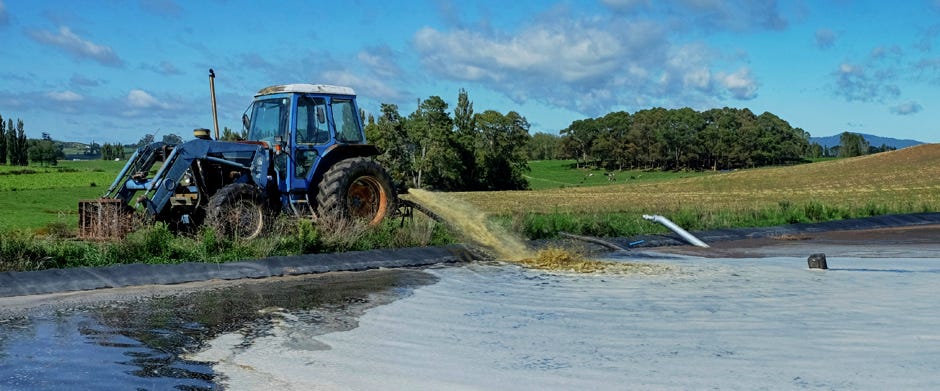
The clearest, most heavily litigated example of this accounting lives in California’s Low Carbon Fuel Standard (LCFS), and it exists in dairy manure — not from fracking water in abandoned oilfields, and that distinction matters enough to hold the line on.
Under LCFS, a fuel’s carbon intensity (CI) score is measured against a baseline figure, but not against zero. For most fuels, it produces a positive or mildly negative number. For dairy-derived biomethane, the counterfactual is an open manure lagoon releasing methane — a gas roughly 80 times more potent than CO₂ over a 20-year horizon — into the atmosphere uncontrolled. Capture and combust that methane instead, and the program credits the avoided lagoon emissions on top of crediting the displaced fossil fuel. The result is a carbon intensity score that can run deeply negative, in some cases hundreds of grams of CO₂-equivalent per megajoule below zero.1
Regulatory finding on scale of the problem — California's State Water Resources Control Board (SWRCB) has identified dairy manure as the greatest contributor of nitrates in Central Valley groundwater, a finding driving a new regulatory push that dairy operators have pushed back on as costly.
Hanford Sentinel, July 2026
This is not a fringe interpretation. It’s also not uncontested. The Union of Concerned Scientists has argued how manure-methane crediting functions less as transportation fuel policy and more like an offset program wearing a fuel-standard costume — and that, by CARB’s own 2023 numbers, the large majority of credits generated under this pathway have nothing to do with transportation emissions at all.2 Canary Media and various peer-reviewed lifecycle analysis have raised a parallel concern: because these credit values scale with the size of the manure-management liability being solved, the program could be quietly incentivising dairies to grow larger and manage waste in ways that generate more methane to capture, not less.3 California’s own regulators have opened a separate process specifically to examine whether livestock methane needs direct regulation independent of the credit market that currently rewards it.4
None of that invalidates the mechanism itself. However, it does suggest that “carbon-negative” claims are a policy construct, not a law of physics — and any investor-facing material built on it should say so in the first paragraph, not the footnotes.
Why this pathway closes the loop — and produced water doesn’t
Oil and gas produced water and municipal wastewater are both part of a bigger GH2E feedstock discussion, and they carry real economic potential: treatment-as-a-service revenue, disposal-cost avoidance, and — where 45V thresholds are met — hydrogen capture tax credit eligibility.5 But neither one currently has a comparably established, third-party-litigated negative baseline the way dairy manure does under LCFS Tier 1. Produced water’s emissions profile is dominated by upstream extraction and disposal-well logistics, not as a clean or quantifiable “gas that would otherwise have escaped” counterfactual. Treating it as carbon-negative feedstock invites exactly the kind of reconciliation gap that shows up under diligence later. Agriculture doesn’t have that problem, because the counterfactual — an uncovered lagoon, quantified against the Tier 1 or Tier 2 CARB calculator — is already the regulatory baseline other participants follow today.6
UC Davis groundwater research quantifies the mechanism directly, estimating that dairy lagoons and animal holding areas leach roughly 6 thousand tonnes of nitrogen to groundwater systems annually, on top of a broader finding that confined animal feeding operations (CAFOs) rank among the land uses with the highest estimated nitrogen loading rates in the region.
So the cleanest way to state the process is this: the carbon-negative claim belongs to agriculture. Oil & gas and municipal waste are legitimate, valuable feedstock and treatment markets for the platform’s Track A financial dynamics — but they should be underwritten as carbon-avoided or carbon-neutral opportunities, not folded right into the same negative-CI framing that dairy manure earns through an established, if not contested, regulatory pathway.
The federal overlay
Layered on top of the state-level LCFS credit is Section 45V of the Inflation Reduction Act, which pays qualifying clean hydrogen producers up to $3.00 per kilogram on a sliding four-tier scale tied to lifecycle emissions intensity, verified against the 45VH2-GREET model and calculated through the point of production.7 The ceiling requires lifecycle emissions below roughly 0.45 kg CO₂e per kg of hydrogen produced — well within reach for a feedstock that starts from a negative baseline.8 Facilities have until the start of 2033 to break ground to qualify, and these credits run for ten years once operational.9 Stacked correctly, an agriculture-sourced hydrogen project can capture LCFS credit value, 45V federal credit value, and the underlying treatment or disposal-cost avoidance simultaneously — three revenue lines from a single tonne of manure that used to be a cost centre.
What this means, sector by sector
Agriculture is where the usage loop actually closes. Manure and ag residue move from liability to layered revenue stream, within a regulatory-grade negative CI baseline to underwrite against — provided it explicitly carries the policy-risk caveat above.
Oil & gas remains a strong Track A treatment and disposal-cost-avoidance market, but a clear and concise framing is carbon-avoided, not viewed as carbon-negative, until a comparably rigourous baseline exists for produced water the way it does for manure.
Municipal waste sits in similar territory to oil & gas: real infrastructure decarbonisation value, real treatment economics, but a case that should be built on avoided landfill or wastewater-treatment emissions (WWTE) rather than borrowing agriculture’s negative-CI framing.
The throughline for all three is the same platform analysis that has carried this entire series from the beginning — waste re-rated as infrastructure. But the strength of the carbon-negative claim isn’t uniform across feedstocks, and pretending otherwise is the fastest way to hand a due-diligence team a reconciliation problem rather than a thesis.
Sources and references
Union of Concerned Scientists, “Something Stinks: California Must End Manure Biomethane Accounting Gimmicks in its Low Carbon Fuel Standard,” March 2024.
Ibid.
Canary Media, "California could lock in disastrous dairy methane rules, advocates warn," October 2024; ScienceDirect, "Risks of crediting carbon offsets in low carbon fuel standards: lessons learned from dairy biomethane," July 2025.
Inside Climate News, "California Explores First-Time Regulation on Dairy Methane Emissions," February 2026.
U.S. Department of Energy, "Clean Hydrogen Production Tax Credit (45V) Resources," January 2025.
NYSERDA, "California LCFS Carbon Intensity Applied to NYS Dairies," Fact Sheet Series; American Biogas Council, "101 for Low Carbon Fuel Standard."
U.S. Department of the Treasury, "Treasury Releases Final Rules for Clean Hydrogen Production Tax Credit," January 2025.
Congressional Research Service, "The Section 45V Clean Hydrogen Production Credit," March 2026.
Trinity Consultants, "Navigating the Clean Hydrogen Production Tax Credit Final Rule," April 2026.